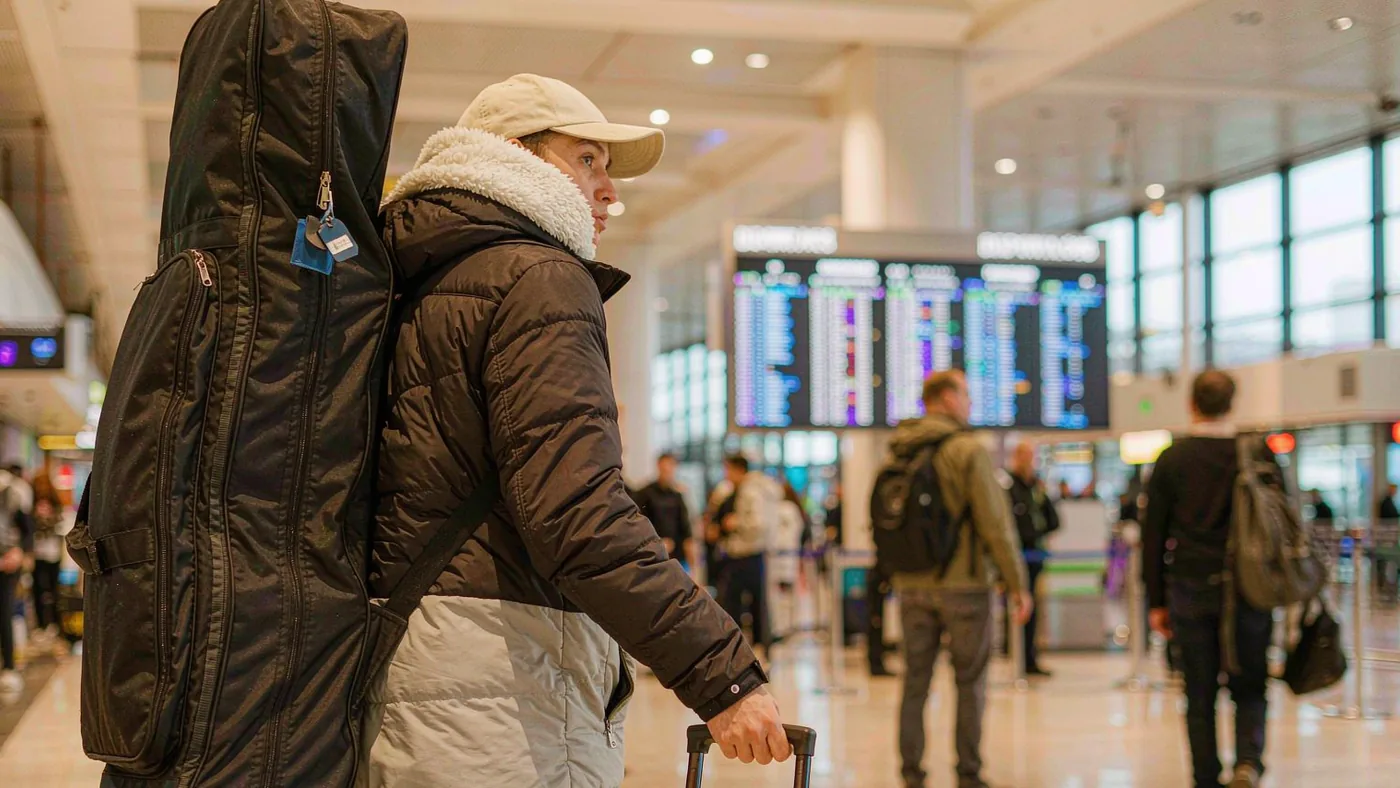
It is 5:40 in the morning at Geneva and the queue for sports equipment drop-off is already the longest line in the terminal. Four people ahead of you are wrestling padded bags onto a belt that will not take the weight, one has a bag with a torn end where a board tip has come through, and the check-in agent is looking at a scale that has just gone into read. Somewhere behind you, your transfer leaves in fifty minutes.
Most of what goes wrong with flying gear is decided before you leave the house: how much the bag weighs, how well it protects what is inside, and what you packed into it instead of your boots. Get those right and the airport becomes a five-minute stop rather than the worst part of the trip.
What airlines actually charge for
This is the part that changes most often, so treat it as a category rather than a set of rules. Most carriers treat a snowboard bag as a piece of sports equipment rather than ordinary luggage, and their policies fall into two broad types. Some include it within your standard checked allowance, provided it is under the weight limit and within a size limit. Others charge a flat sports-equipment fee per bag, per direction, on top of your allowance.
A few things follow from that. Check the specific airline's sports equipment page when you book, not the week before you fly, because terms change and the difference between carriers is large. A bag slightly over the weight limit is the most common and most avoidable extra charge. And since a return trip is charged twice, compare the total cost of the flight plus the bag rather than the headline fare alone.
Choosing a board bag
| Bag type | Protection | Weight | Ease of travel | Best for |
|---|---|---|---|---|
| Unpadded or lightly padded sleeve | Low | Lowest | Easy to carry, hard to protect | Local trips in a car, not flights |
| Padded wheeled board bag | Good | Moderate | Good, especially with a handle at the right height | Almost all travelling riders |
| Two-board padded bag | Good | High before you have packed anything | Awkward in small cars | Two riders travelling together |
| Hard shell case | Highest | Highest | Bulky and heavy to handle | Riders who need maximum protection |
Editorial comparison of board bag types, last reviewed 28 September 2026. Weights vary considerably between individual models, and a heavy bag is a problem before you have packed anything into it.
Wheels are worth having. A padded bag with a decent wheel set and a handle at trolley height moves through an airport far more easily than a bag you carry by the strap. The trade-off is weight: wheels and a rigid base add mass, which matters if the airline limit is tight. Also check the length when you buy. A bag long enough for your board with a little room at each end protects the tip and tail; a bag exactly the length of the board means every impact goes straight into the ends.
Packing so the board survives
Boards rarely break in the middle. They break at the tip and the tail, and they get damaged by other people's luggage, which is why the ends need the most protection.
Wrap the tip and tail in something soft — a spare fleece, your coat, a towel — and put the padding at the ends of the bag rather than in the middle. Pack the space around the board with soft items rather than leaving it loose. Clothing is good. Anything rigid is not, because a rigid object inside a flexible bag becomes the thing that dents a base.
Take the bindings off, or leave them on and protect them. If you leave them mounted, the highbacks and the baseplates are the hard lumps inside the bag, and they are what presses into the base when something lands on top. Wrapping the board in a cloth or putting the bindings against a padded base panel solves most of it. If you take the bindings off, put the screws in a bag inside a boot so they do not disappear.
Do the bag up, then strap it tight. A loose bag moves and the contents settle into the gaps. If your bag has compression straps, use them. Some riders also add a layer of wide tape around the middle and ends, which helps with the handling that goes on out of sight.
Weight limits and what belongs in hand luggage
Once the board, bindings and a padded bag are together, the total is heavier than most people expect. There are two ways to bring it down.
The first is to put your boots in your hand luggage. Boots are dense and heavy, they are the item you most need to arrive with you, and they take up room in the board bag without providing much protection. If your boots are in the cabin, a lost board bag is an inconvenience rather than a ruined holiday. Check the dimensions against the airline's cabin allowance, and be ready for a polite conversation at the gate.
The second is to carry your outerwear in the cabin too, wearing the heaviest jacket. Padded jackets and trousers are bulky and light, which is exactly what you want out of the board bag when weight is the constraint.
What cannot go in hand luggage is anything with tools: a screwdriver, a multi-tool or an edge file will be taken off you at security. Put those in the checked bag, or leave them at home. Wax and snowboard tools are generally treated as ordinary solid items, but anything that could be used as a weapon will be treated as one, so check the hand luggage rules for the airport you are flying from if you are unsure.
If you carry an avalanche airbag pack, check the policy well ahead. Some airlines refuse the pressurised canister outright, others allow it only if it is disarmed and declared at check-in, and policies differ between carriers. Turning up at the desk with an undeclared canister is how a pack gets left behind.
At the airport, and once you arrive
At check-in, expect to be sent to an oversized baggage counter rather than the normal belt. Build in the extra walk and the extra queue, particularly at a busy Alpine airport on a Saturday in February, when half the terminal is doing exactly the same thing. Before you hand the bag over, take a photograph of it, and keep the bag tag receipt somewhere you can find it.
Then think about how you will get from the airport to the resort. A board bag takes up roughly the space of a person, and a small hire car with four passengers and four board bags on a Saturday morning is a genuine problem. Many riders book a shared or private transfer specifically because minibuses handle bags properly.
Verdict
If you are hiring a board in resort and only taking boots, gloves and outerwear, none of this applies to you — put the boots in the cabin and travel normally. This advice is for riders who own their board and want it to arrive intact and uncharged, and who ride enough days a year that the cost of a padded wheeled bag is worth it.
Frequently asked questions
Do airlines charge extra for a snowboard bag?
It depends on the airline. Some include a snowboard bag within your standard checked baggage allowance if it is under the weight limit, while others charge a flat sports equipment fee per bag for each direction of travel. Policies change often, so check the specific airline's sports equipment page when you book.
Can I put my snowboard in a normal suitcase?
Only if it fits, which it will not. Snowboards need a long, purpose-made bag, and a board forced into a normal case will either smash the case or arrive bent. A padded board bag is the minimum for anything beyond a car journey.
Can I take my snowboard boots in hand luggage?
Usually yes, if they fit within the cabin size allowance, and it is a sensible thing to do. It takes weight out of the checked bag and means a lost board bag does not leave you without boots. Be prepared for the bag to be checked for size at the gate.
Can I fly with an avalanche airbag pack?
Sometimes, but never assume. Some airlines do not accept the pressurised canister at all, and others require it to be disarmed and declared at check-in. Contact the airline before you travel and get the answer in writing, or plan to travel without the canister.
Where to go next
Before you travel, run through the pre-trip checklist and give the board the maintenance it needs — the care and storage guide covers waxing and edges, and waxing and tuning at home goes deeper. If you would rather travel with one board that does everything, the all-mountain round-up and the size chart are the places to start.
If the trip is your first, read the first season guide and the first setup guide. More travel and buying advice sits in the buying-guides archive.