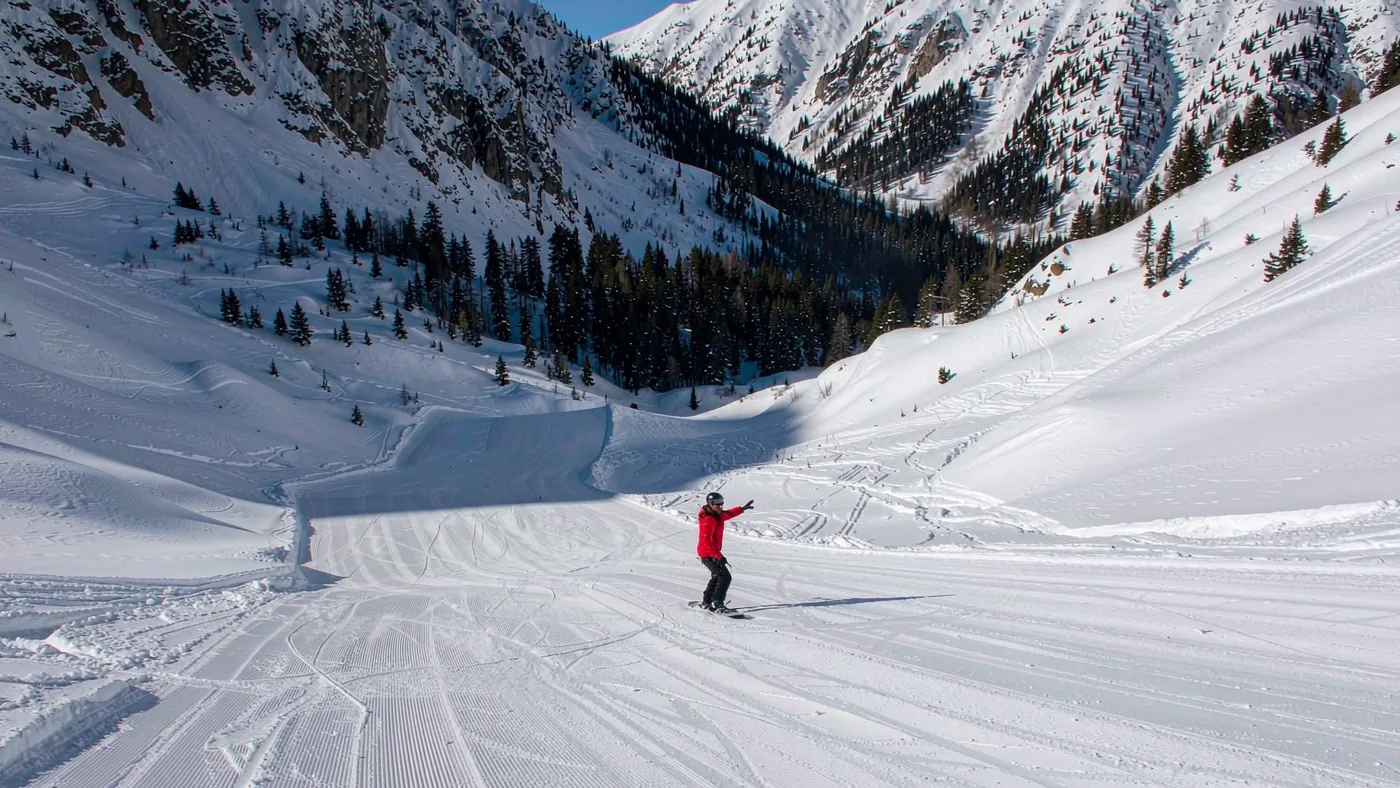
At 8:40 on a January morning in Laax, the first few metres under the Crap Sogn Gion chair are blue-grey boilerplate, polished by everyone who beat you to the lift. Two riders push off together. One board locks into the ice and holds a clean line across the traverse. The other chatters, skids sideways and straightens out just to survive. The difference between them is not bravery or technique. It is four or five millimetres of curve under their feet.
Rocker and camber are the two ends of that curve, and the argument between them has rumbled on since snowboard builders borrowed the shapes from surfboards. Almost nothing on a shop wall today is purely one or the other. Most boards are hybrid profiles — part camber, part rocker, arranged differently depending on what the designer wanted the deck to do. That is why the debate feels muddier than it used to.
Here is the short version, then the detail.
If you ride one or two weeks a year on European pistes, camber under and between your feet is what keeps you upright on the first run of the day. If you ride a lot of soft snow, or you are still learning and want to stop catching edges, a rocker-dominant or hybrid profile will make the week considerably more enjoyable. Neither is better. They answer different questions.
What camber and rocker actually do
Traditional camber arches the board upward between the contact points. Stand on it and your weight flattens the middle, which loads the tips and presses the running edge into the snow along its whole length. That gives you three things: edge hold on hardpack, pop because the board is a loaded spring, and a board that punishes laziness. In deep snow a cambered board wants to dive rather than plane, and it has a habit of catching an edge on flat, slow traverses.
Rocker reverses the curve, bending the board upward away from the snow either through the middle or just at the tips. The result is a board that is loose, playful and hard to catch, and in soft snow the tips plane instead of digging, so you float with far less effort. The compromise is grip. Where camber presses the edge in, rocker releases it, so on genuine boilerplate a heavily rockered board can feel vague and skittish, particularly at speed and particularly under a heavier rider.
The hybrids you will actually find in shops
Almost every board you can buy sits on a spectrum between those two extremes. The families are worth knowing by name, because shop staff will use them.
| Profile family | What it looks like | How it feels | Best suited to |
|---|---|---|---|
| Traditional camber | Continuous arch between the contact points | Grippy, poppy, precise | Hardpack, carving, fast piste riding |
| Flat with rockered tips | Flat underfoot, tips lifted clear of the snow | Neutral, forgiving, hard to catch | Beginners and occasional riders |
| Rocker between the feet, camber at the contact points | Reverse arch in the middle, load at the tips | Loose in the centre, grippy at the edges | Park laps, butters and soft snow |
| Camber between the feet, rocker in the tips | Camber underfoot, tips and tail lifted | Grip underfoot with easier float | All-mountain riders wanting both |
| Rocker-dominant hybrid | Mostly reversed with a small camber zone | Very floaty and surfy | Powder days and soft snow |
Profile descriptions follow how manufacturers publish their own designs. How a board feels also depends on flex, sidecut and length, so treat this as a starting point rather than a rule.
Winner by scenario
| Scenario | Which profile wins | Why |
|---|---|---|
| Icy first run at 8:45am in January | Camber | Pressure along the whole running edge is what stops the skitter |
| Learning to link turns in week one | Flat or rocker-tipped | Forgiving tips mean far fewer edge catches |
| Boilerplate at speed on a long red | Camber, or a hybrid with strong camber underfoot | Speed amplifies every wobble on a rockered deck |
| A genuine powder day | Rocker-dominant or a tapered rocker hybrid | Float comes for free instead of needing a sit-back stance |
| Wet, heavy snow in Scotland or the lower Alps | Hybrid camber | Enough grip for the crust, enough lift to stop the nose ploughing |
| Park laps and side hits | Rocker between the feet | Pressing and butters are much easier on a loosened centre |
| One board for one trip a year | Hybrid camber | The least compromised answer across a week of mixed conditions |
Editorial judgements about how each design behaves, based on published specifications rather than measured testing.
Which should you buy
If you have to pick one deck and you are honest with yourself about riding mostly groomed pistes with the occasional soft day, a hybrid camber board — camber between the feet, rocker in the tips — is the least regret-prone choice. It grips when the surface demands it and floats better than its label suggests.
If you are a beginner, do not let anyone talk you into a full-camber deck on the grounds that it teaches better technique. You will spend the first week catching edges, and catching edges is how people get hurt and decide snowboarding is not for them. A flat-to-rocker shape will have you linking turns sooner, and you can move to a cambered board once you are genuinely controlling your edges.
If you ride well already and travel to chase powder, a rocker-dominant or tapered directional deck earns its place. Treat it as a second board rather than your only one.
If you ride mostly hard, refrozen pistes, or you are heavy and like to go fast, do not make a heavily rockered board your only deck. It will feel imprecise exactly when you need it to hold. Equally, beginners should not buy a stiff full-camber board because someone told them it teaches better habits. Buy the profile that matches the snow you actually ride, and hire the other one for the week you go chasing fresh snow.
Frequently asked questions
Is camber better than rocker?
Neither is better in the abstract. Camber gives grip, pop and stability, which suit hardpack and fast piste riding. Rocker gives float, forgiveness and playfulness, which suit powder and beginners. The right answer depends on the snow you ride most and how much edge grip you are willing to trade away for float.
Can I learn on a cambered board?
You can, and plenty of people did for decades. But a cambered board is more likely to catch an edge at low speed, which is where beginners spend their time. A flat or rocker-tipped shape removes a lot of those falls from the first three days and lets you build mileage instead of fear.
Does a rockered board mean I cannot carve?
No. A rocker-dominant board still carves, it just asks more of your technique and gives less back at high speed. Modern hybrid shapes place a camber zone underfoot precisely so that riders can carve properly while keeping the tips loose in soft snow. Rocker is a compromise, not a disqualification.
Do I need a different profile for powder?
Yes, if powder is genuinely the point of your trip. A rocker-dominant or tapered directional shape floats with far less effort and lets you ride a shorter board in trees. If powder is a bonus day in an otherwise groomed week, do not buy for it — hire a powder board for the day.
Where to go next
The camber profiles guide takes the same subject board by board, and the all-mountain vs freestyle comparison explains how shape and flex change what a deck is good at. If you are still choosing a length, start with the snowboard size chart.
For the wider picture, see our all-mountain round-up and the beginner board guide, then browse the rest of the comparisons section.