It is minus twelve at the bottom of the lift in Villars, first run of the morning, and you have made a mistake with your gloves. One of the laces on your left boot has frozen into the knot you tied in the warm apartment. You get a glove off, pull the lace with a bare hand, feel the cold bite, get one loop loose, and by the time you stand up your fingers are useless and the group has gone. A rider on a dial boot is already clipped in, hands still in their mitts.
That is the case for Boa in one scene, and it is a good one. It is also only one scene. The position on this site is straightforward: Boa is the better system for speed and for anyone who struggles with cold hands, and traditional laces are the better system for a rider who keeps boots for several seasons, repairs their own kit, or wants the finest control of how tight each part of the boot is. Both are perfectly good, and the difference will not change how well you ride. It changes how much you fiddle.
What the closure actually changes
Speed. A dial tightens in one motion, with gloves on, without looking. Laces need two hands, a knot and, in cold conditions, bare fingers. Across a week that is a few minutes of comfort and a lot less swearing.
Consistency. Boa tension is repeatable: tighten until it stops and it is the same every time. Laces depend on how hard you pull and how the knot settles, which is why the same boot can feel different on Tuesday and Thursday.
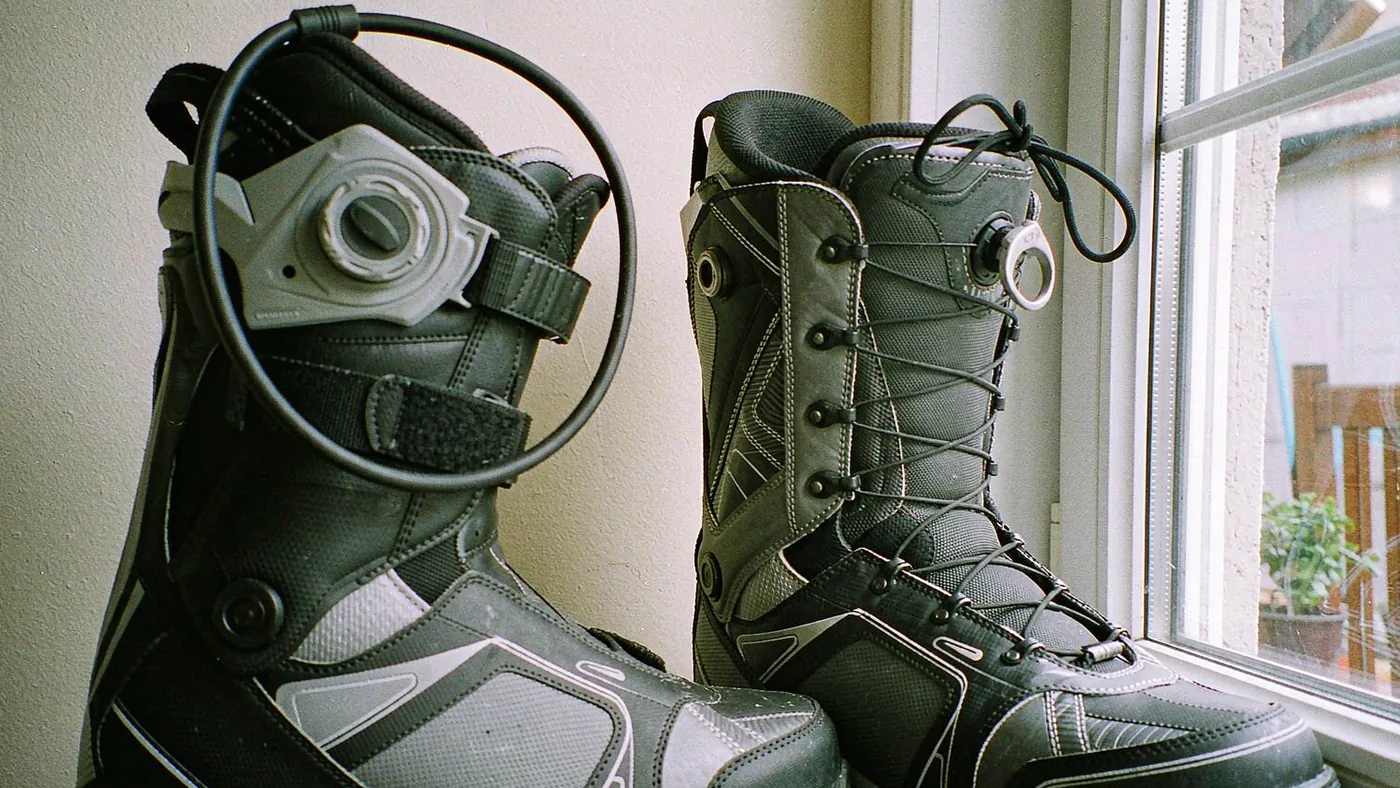
Where the tension goes. This matters most for fit and gets researched least. A single-zone Boa tightens the whole boot through one route, so pulling the heel tight also tightens the top. A dual-zone system gives two independent dials — lower shell and instep, then cuff — which is the difference between a system that fights your foot shape and one that works with it.
Repair. A broken lace is replaced anywhere with a spare from a rucksack, and a frozen lace is an annoyance rather than a disaster. A snapped cable or stripped dial is a shop job, and on day two of a trip that is the rest of the week compromised.
The picks
A lower-volume boot that grips a narrow foot properly. If standard boots leave your heel lifting, this is the shape to try.
Best for
- Narrow and low-volume feet
- Riders with heel-lift problems
Worth skipping if
- Wide or high-volume feet
- Flex bias
- Medium
- Lacing
- Traditional laces
- Intended terrain
- All-mountain
Strengths
- Proper heel hold for narrow feet
- Supportive for a mid-flex boot
Trade-offs
- Too tight for high-volume feet
- Limited size availability at times
Specifications reflect published manufacturer information, last checked 2026-09-28. We have not laboratory-tested this product; the assessment above is editorial, based on the published design and the rider profile it targets. How we review gear.
A comfortable, mid-flex boot that suits riders splitting time between park and groomers. Wide-ish fit and a reputation for lasting.
Best for
- Park and piste riders
- Riders who want one boot for everything
Worth skipping if
- Riders wanting a very stiff freeride boot
- Very narrow feet
- Flex bias
- Medium
- Lacing
- Traditional laces
- Intended terrain
- All-mountain freestyle
Strengths
- Comfortable immediately, no long break-in
- Holds up over multiple seasons
- Versatile flex for most riders
Trade-offs
- Neutral fit suits average-width feet best
- Not the lightest option
Specifications reflect published manufacturer information, last checked 2026-09-28. We have not laboratory-tested this product; the assessment above is editorial, based on the published design and the rider profile it targets. How we review gear.
Both of those boots are laced, and that is a deliberate editorial position rather than an oversight. For most riders we write for — one or two weeks a season, a setup kept for years, no shop within an hour at home — laces remain the lower-risk purchase. Their fit is where the two differ, and fit beats closure every single time.
How they compare
| Single-zone Boa | Dual-zone Boa | Speed-zone lacing | Traditional laces | |
|---|---|---|---|---|
| Tightening speed | Fast, one motion | Fast, two motions | Fast, one pull | Slow, two hands |
| With gloves on | Yes | Yes | Yes | Awkward to impossible |
| Tension consistency | High | High | High | Variable |
| Instep control | Coarse | Precise | Finer than a single dial | Finest, zone by zone |
| Field repair | Shop or warranty | Shop or warranty | Replaceable lace | Replaceable lace |
| Main failure mode | Cable snap or dial strip | Cable snap or dial strip | Lace or lock wear | Lace wear or a frozen knot |
| Long-term serviceability | Limited at home | Limited at home | Moderate | Total, anywhere |
| Cost tier | Highest | Highest | Middle | Lowest |
Published specifications, last checked 28 September 2026. Judgements about speed, control and failure likelihood are editorial assessments of how each system behaves in use, not measured comparisons.
The failure mode of each, honestly
Where Boa fails. Not often, but it fails unrecoverably on the mountain. A cable can fray and snap, a dial can strip, and the lace route through the shell can be snagged by a chair or a board edge. The fix is a replacement kit or a warranty claim, which is fine at home and miserable at the start of a week. Snow and ice packing into the dial is the everyday annoyance, needing a knock before it turns freely.
Where laces fail. More often, more cheaply and more visibly. Laces fray, wear through at the eyelets, freeze into knots, and stretch over seasons so that the boot you loved in year one needs a harder pull in year three. A spare pair costs almost nothing, lives in a jacket pocket and fits in two minutes with no tools.
What actually decides it
Buy Boa if you stop often. Riders lapping a small resort or riding with beginners get the most out of a dial. The saving per stop is unremarkable; the saving across a day is not.
Buy Boa if your hands suffer. Cold hands, poor circulation, or a genuine dislike of taking gloves off in the wind are the least arguable reasons. No lace improvement scheme answers that problem.
Choose dual-zone over single-zone if the fit is close. A high instep, a narrow heel or a history of heel lift makes the extra zone the difference between a good boot and a frustrating one. On an average foot, a single dial is enough.
Buy laces if you keep kit. A laced boot is a five-season object: you can replace a lace at home, adjust one zone without touching the others, and nothing on it depends on a proprietary part.
Verdict
If you ride a fortnight a year with no shop you trust nearby, and you keep boots for years, do not pay extra for a Boa boot — the speed gain is small at your riding frequency and the failure modes are the ones you cannot repair yourself. If your hands hurt in the cold, though, ignore our picks and buy a dual-zone dial boot instead.
Frequently asked questions
Is dual-zone Boa worth the extra money over single-zone?
Yes if your foot shape is awkward, rarely if it is average. Two zones let you lock the instep and the cuff independently, which is what stops heel lift on a high instep or a narrow heel. On a straightforward foot a single dial achieves almost the same wrap.
Can you replace a Boa cable yourself?
Sometimes, depending on the system and whether spare kits are sold in your region. Many riders fit a replacement at home with the kit and a small tool. Treat it as a possibility rather than a guarantee, and ask the shop what parts it stocks before committing.
Do laces really freeze?
Yes, in cold and wet conditions, and a knot that has iced up is genuinely hard to open with gloves on. Waxed laces help and tucking the bow under the boot flap helps more, but the only complete answer to frozen laces is a dial or a speed-zone system.
Which closure gives a better fit?
Traditional laces give the finest control, because you can tension the lower shell, the instep and the cuff separately by hand. Dual-zone Boa comes close with far less effort. What actually determines fit, though, is shell size and liner, not the closure.
Is a laced boot lighter than a Boa boot?
Slightly, because there is no dial, cable route or extra hardware. The difference is small enough that most riders will not notice it on snow, and it is not a good reason to choose one over the other. Fit and flex matter far more.
Where to go next
Before you choose a closure, choose a size — the boot size guide explains Mondopoint and why shoe size misleads. If the boots are already the right size and still hurt, our piece on breaking in and fixing boots covers what actually helps.
Riders comparing systems across the whole boot range should read the mid-range boot round-up, and anyone worried about support rather than closure should start with stiff vs soft boots. More sits in the comparisons archive.