The most common sentence at a hire desk in Alpe d'Huez is some version of this: the nine crushed my toes, so I took the ten. It sounds sensible. It is also how most people end up riding boots a size too big for the next five years, because the nine was the right length and the wrong width, and the ten fixed the wrong problem.
A boot that is too long does not feel wrong in the shop. It feels comfortable, which is the trap. On snow, your foot slides forward on every heel-side turn until your toes press the front, your heel lifts out of the heelcup, and the only thing transferring weight to the board is the strap across your instep.
Why your shoe size is the wrong starting point
Four things sit between the number in your shoe and a boot that fits.
Shoe sizes are labels, not measurements. A UK 9 is not a length; it is a label attached to a particular last. Trainers are built roomy for toe splay, dress shoes narrow. Neither has anything to do with the shell you are about to strap on.
Feet change through the day. Volume rises with standing, warmth and altitude, so the foot that measured 272 mm at breakfast can be a few millimetres longer by late afternoon. Length also drifts slowly with age and weight.
Liners pack out. Foam compresses where your foot presses hardest, so a boot that felt snug in November can feel roomy by February. It is a couple of millimetres of material, not a size, which is exactly why a new boot should feel snug rather than comfortable.
Boots are a system. Two boots in the same nominal size can differ in width, instep volume and heel pocket. Shoe size speaks to one dimension of four.
Mondopoint is the fix, and it is simpler than the name suggests: it is your foot length in millimetres. A 275 mm foot is MP 275. Some manufacturers print a width code beside it, so 275/98 means a 275 mm foot in a 98 mm-wide last — useful if your forefoot is narrow or wide. The number on the boot box, by contrast, describes the boot. The shell has to be longer than your foot, because of the heel structure, the toe box and the liner's own thickness, which is why a printed sole length is typically two to three centimetres longer than the foot inside it. Comparing that figure with your shoe size tells you nothing.
Measuring your foot, and the two checks that prove the fit
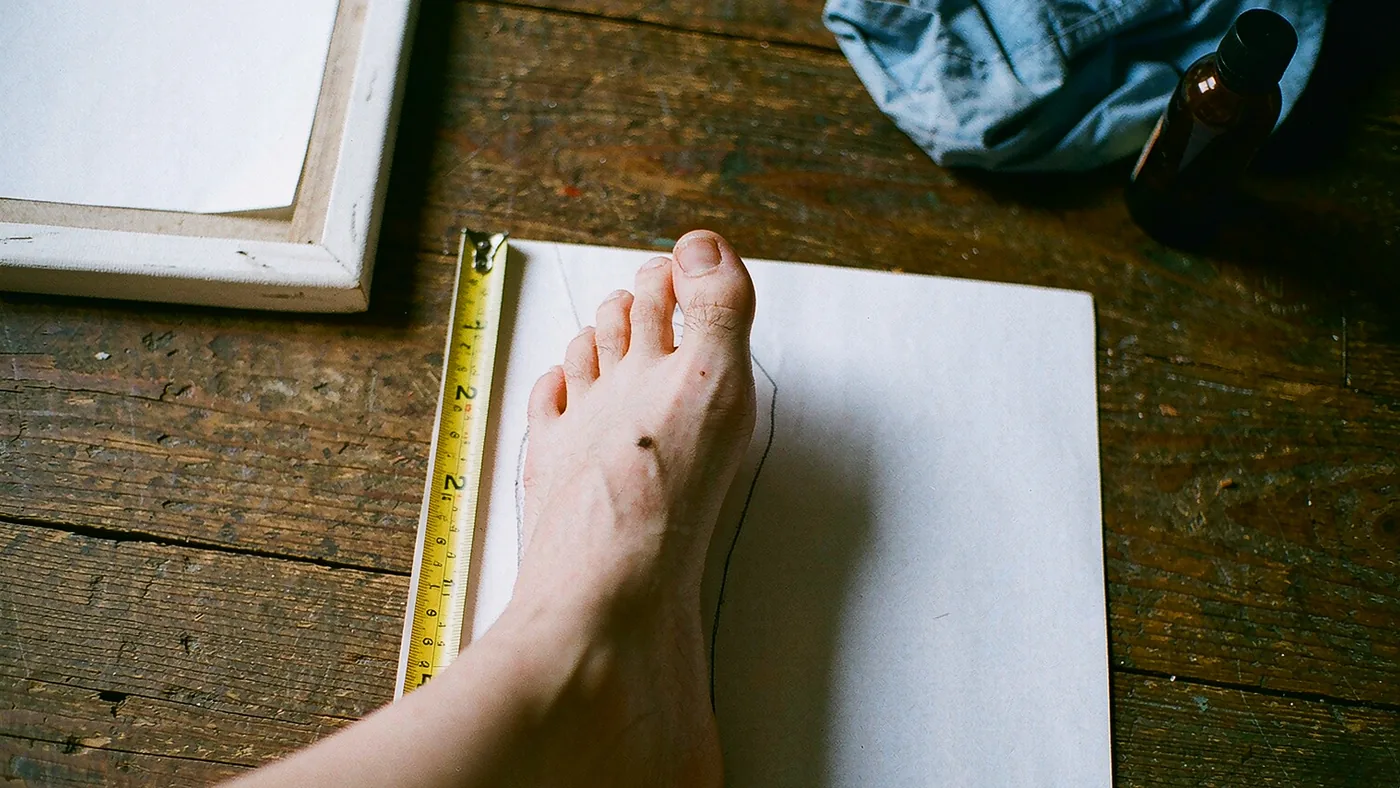
Measure in the evening, in the socks you ride in. Stand with your heel against a wall and your weight on that foot — feet lengthen under load — then mark the tip of your longest toe, often not the big toe, and the back of the heel. Do both feet and use the longer one.
In a shop, the fitting bench normally starts with a shell check. Pull the liner out, put your foot in the empty shell with the heel against the back, and look at the gap behind your heel. Roughly a finger's width, about fifteen to twenty millimetres, is the conventional starting point. Toes touching the front of the shell means the shell is too small, whatever the label says.
Two tests confirm the fit once the liner is back in and the boot is laced.
Heel hold under flex. Fasten the boot as you would ride it, hold the heel down, and flex forward at the ankles. Your heel should lift by no more than a few millimetres. More than that and you will be riding on your toe strap all season.
Toe contact in the riding position. With your knees bent as they are in a turn, your toes should just brush the front of the boot. Standing straight they may pull back slightly. Toes jammed while you stand upright means too short; feet that wiggle freely with knees bent means too long.
| Nominal boot size | Foot length it suits | Mondopoint equivalent | Typical printed sole length | How the liner should feel when new | The mistake to avoid |
|---|---|---|---|---|---|
| UK 7 and under | up to about 255 mm | MP 250–255 | around 280–290 mm | Snug all round, toes brushing the front | Sizing up to cure forefoot pressure |
| UK 8 | about 260–265 mm | MP 260–265 | around 290–295 mm | Firm hold, no side-to-side movement | Trusting a shoe size instead of a measurement |
| UK 9 | about 270–275 mm | MP 270–275 | around 295–300 mm | Heel locked, slight toe contact | Buying the same size as your trainers |
| UK 10 | about 275–280 mm | MP 275–280 | around 300–305 mm | Even pressure, no hot spots | Ignoring instep volume on a high arch |
| UK 11 | about 285–290 mm | MP 285–290 | around 305–315 mm | Firm, widest at the ball of the foot | A standard-width boot on a wide foot |
| UK 12 and above | 295 mm and up | MP 295 and up | 315–320 mm and above | Tight but pain-free everywhere | Overlooking a dedicated wide model |
Published sizing conventions and editorial fitting guidance, last checked 28 September 2026. Sole lengths and Mondopoint conversions vary between brands and lasts, and the liner-fit column is judgement rather than measurement.
The picks
Two mid-range boots that show how differently two similar-looking products can fit. Neither is a bargain-bin beginner boot, and both assume you have measured first.
A supportive boot that will still be worth wearing once you can ride properly. Good if you only want to buy boots once.
Best for
- Improving riders who want support
- Riders with an average-width foot
Worth skipping if
- Absolute beginners
- Riders wanting maximum softness
- Flex bias
- Medium-stiff
- Lacing
- Quick-pull lacing
- Intended terrain
- All-mountain
Strengths
- Supportive without being brutal
- Lasts several seasons
Trade-offs
- Firmer than a beginner wants
- Costs more than an entry boot
Specifications reflect published manufacturer information, last checked 2026-09-28. We have not laboratory-tested this product; the assessment above is editorial, based on the published design and the rider profile it targets. How we review gear.
A well-rounded mid-flex boot that suits most riders. Good comfort out of the box and enough support for piste riding.
Best for
- Most riders
- Riders wanting one boot for everything
Worth skipping if
- Riders with very narrow feet
- Extreme freeride
- Flex bias
- Medium
- Lacing
- Quick-pull lacing
- Intended terrain
- All-mountain
Strengths
- Comfortable quickly
- Versatile flex
- Easy to tighten with gloves
Trade-offs
- Average-width last only
- Laces harder to field-repair
Specifications reflect published manufacturer information, last checked 2026-09-28. We have not laboratory-tested this product; the assessment above is editorial, based on the published design and the rider profile it targets. How we review gear.
Why the same nominal size feels different in two boots
Width and last shape. This is the variable shoe size hides completely. At identical lengths, a boot built on an average-width last pinches a wide forefoot and floats around a narrow one. If you know your foot sits at an extreme, start with the models built for it.
Instep volume. A high instep in a low-volume boot produces pressure across the top of the foot that no lacing adjustment fixes. A low instep in a roomy boot means the foot never locks down.
Heel pocket depth. A narrow heel with a wide forefoot is the hardest combination, because the boot that fits the front rarely holds the back. This is where a boot fitter earns their money.
When to size down, and when not to
Size down when the shell gap is small, the heel lifts and the boot feels comfortable rather than snug — one half step at most, and only in a model you have tried on.
Do not size down to make a boot feel "performance". A boot that hurts in the shop will hurt more on a chairlift, and cold, compressed feet lose both feeling and control. Pain is not a sign that a liner will mould to you; it is a sign that the boot is the wrong shape. And do not buy a size that fits your thinnest socks if you ride in thick ones, because every part of the fitting process is a system and changing one variable changes the answer.
Verdict
If your feet hurt in every boot you try, or one boot always works and the rest never do, stop reading and see a fitter who can measure the foot, shell-check it and press the liner. Riders with very wide or very narrow feet, high insteps or a history of foot surgery should not buy boots online at all, however careful the measuring.
Frequently asked questions
Should snowboard boots be the same size as my shoes?
No. Boots are sized around foot length in millimetres, and a riding boot usually runs half to a full size smaller than an everyday shoe, so a UK 9 trainer often pairs with a UK 8.5 boot. Measure the foot first and work from the manufacturer's own length table.
Why do my toes touch the front of a new boot?
Slight toe contact with the knees bent is normal, because the liner compresses by a few millimetres as it moulds. Crushed toes while standing upright mean the boot is too short; toes that never touch at all mean it is too long.
How much do snowboard boots stretch?
Less than most people hope. The liner packs out by roughly a couple of millimetres where the foot presses hardest and the shell barely changes. Never buy a boot expecting it to stretch into the right size, and never accept pain on the promise that it will improve.
What if one foot is bigger than the other?
Very common, usually by two to five millimetres. Measure both and fit the larger foot. If the difference is more than half a size, a fitter can punch out the smaller boot or pad the liner of the larger one.
Where to go next
Once length and width are right, the next question is how the boot will feel in week two — breaking in snowboard boots covers heat moulding and which pressure points are worth tolerating. If you already know your foot is at an extreme, start with the round-ups for wide feet and narrow feet.
For the shopping stage, the mid-range boots guide explains what the next band up buys, and the first setup guide sets out what order to buy everything in.