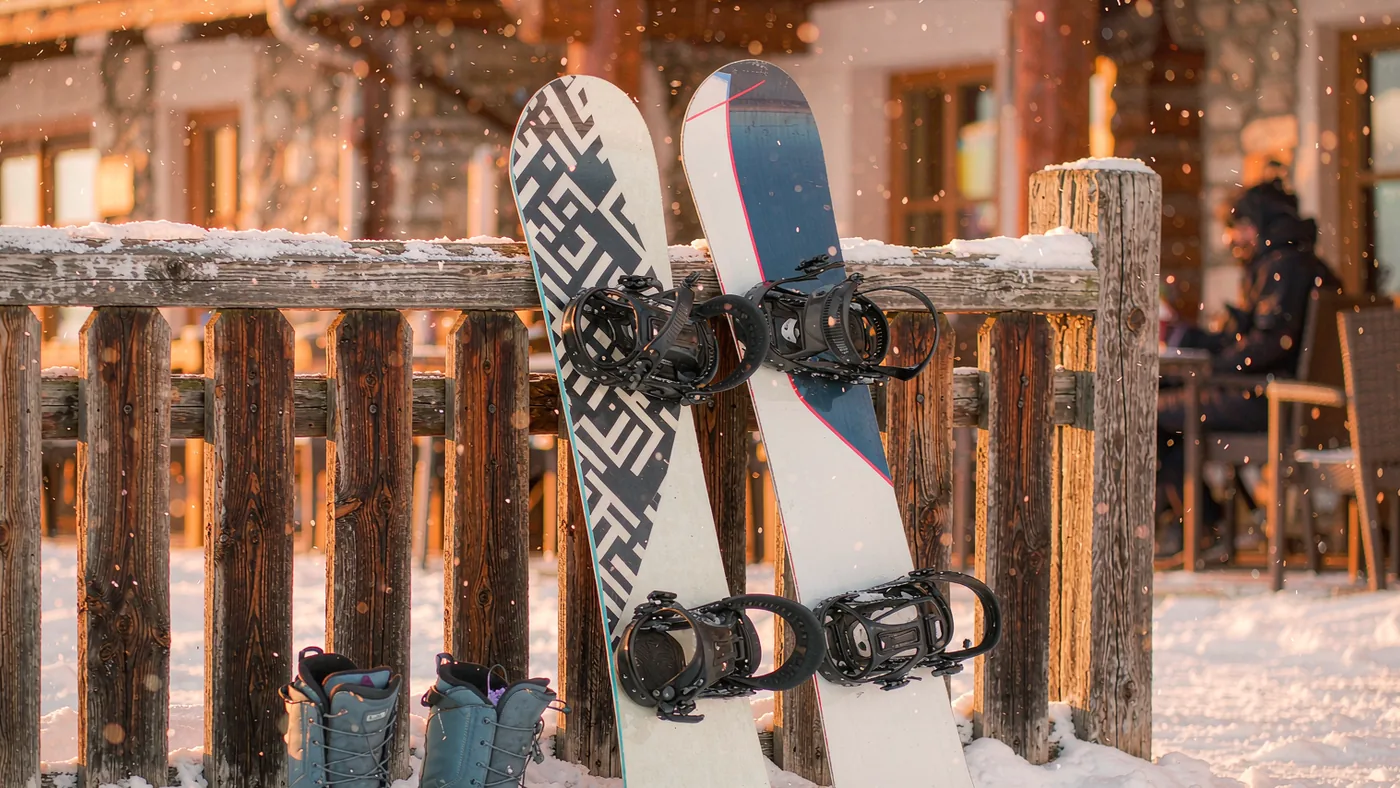

You are standing in the demo room of a shop in Morzine at the end of the day, boots still on, holding two boards because the person serving you asked how tall you are and then handed you something up to your chin. You have no idea whether 156 or 159 is right, and nobody has asked the one question that decides it: how much do you weigh?
Height is a convenient shorthand, which is why it survives. It is also wrong often enough to matter. Two riders of the same height can be twenty kilograms apart, and twenty kilograms is worth roughly five centimetres of board length.
Why the chin-height rule fails
A snowboard bends. The force that bends it comes mostly from your mass and how fast you are going, not from how far above the ground your eyes sit. A light rider on a long board cannot load it properly, so it feels dead, unresponsive and hard to turn. A heavy rider on a short board overpowers it, and it folds and loses grip exactly when the piste gets firm and fast.
There are two other variables the height rule ignores entirely.
Boot size, because a wide foot on a narrow waist drags on every turn. This has nothing to do with length at all.
Board shape, because a modern directional freeride deck, a park twin and a volume-shifted short-wide board all reach a given surface area at completely different lengths.
So use the table below as your starting point, then adjust it for shape and terrain.
The weight-to-length table
Find your weight in the left column first. Add roughly five to seven kilograms to account for boots, bindings and the layers you ride in — if you are between bands, that is usually the tie-breaker and it pushes you into the longer one.
| Rider weight | All-mountain length | Freestyle / park length | Freeride / powder length |
|---|---|---|---|
| 45–54 kg (7–8½ stone) | 144–148 cm | 140–144 cm | 147–151 cm |
| 55–63 kg (8½–10 stone) | 147–151 cm | 143–147 cm | 150–155 cm |
| 64–72 kg (10–11½ stone) | 150–155 cm | 146–150 cm | 154–159 cm |
| 73–81 kg (11½–13 stone) | 154–159 cm | 149–153 cm | 158–163 cm |
| 82–90 kg (13–14 stone) | 157–162 cm | 151–156 cm | 161–167 cm |
| 91–99 kg (14½–15½ stone) | 160–165 cm | 154–158 cm | 164–170 cm |
| 100 kg and above (16 stone and above) | 163–168 cm, in a wide waist | 156–161 cm, in a wide waist | 167–173 cm, in a wide waist |
These are editorial starting ranges for riders of average ability on European resort terrain, based on published manufacturer weight recommendations and standard board geometry. They are a starting point, not a rule. Always check the specific board's own weight range before you buy.
How to read the three columns
All-mountain. The middle ground, and the right column for most riders who own one board. It is long enough to hold an edge at speed on a hard morning and short enough to turn in a narrow section without a fight.
Freestyle and park. Park boards are ridden shorter for a reason: a shorter deck spins faster, presses more easily and feels less like a barrier under your feet on a box. If you spend most of your time in the park but still ride the rest of the mountain, take the top of this range rather than the bottom.
Freeride and powder. Long, and often directional, for float and stability at speed. If you only ride a freeride board on a powder trip and never on a firm piste, you can go to the top of the range or just above it. If it is your only board, stay in the all-mountain column instead — a long directional deck on scraped February hardpack is hard work.
Boot size and waist width
This matters more than length, and it is where people lose money on the wrong purchase. Measure your boot's sole length — it is printed on the shell or the box — and compare it with the board's waist width.
| Boot size (UK) | Typical sole length | Suggested minimum waist width | Width class to look for |
|---|---|---|---|
| 7 and under | up to 290 mm | 240 mm | Standard or narrow |
| 8 | around 295 mm | 245 mm | Standard |
| 9 | around 300 mm | 248 mm | Standard |
| 10 | around 305 mm | 252 mm | Standard to mid-wide |
| 11 | 310–315 mm | 255 mm | Mid-wide |
| 12 | 315–320 mm | 260 mm | Wide |
| 13 and above | 320 mm and up | 265 mm and above | Wide, or a dedicated wide model |
Sole lengths are approximate and vary between brands and models. Check your own boot, and if you are between sizes on the boundary of a wide board, take the wider option. Toe and heel drag on a hard turn is a control problem, not a cosmetic one.
Overhang of a centimetre or so on each side is normal and fine. If your toe is hanging two centimetres or more past the edge, you are giving up leverage and you will feel the boot touching down in hard carves. The fix is a wider board, not a longer one.
Adjusting up or down
Once you have a number from the table, three things move it.
Ability. Confident riders often go up one size within their band for stability; newer riders should sit at the bottom of the range, where the board bends more easily and forgives mistakes.
Weight change. If you are carrying more or less than you were last season, recheck. A rider who loses ten kilograms will find last year's board stiff and sluggish.
Where you ride. Two weeks of Alpine piste in February and a couple of Scottish days in wet snow is a different brief from a week of powder in Japan. If your riding is mostly hardpack, do not size up beyond your band to chase float you will never use.
Volume-shifted boards
Short-wide boards break the chart deliberately. A volume-shifted deck is ridden five to ten centimetres shorter than the table suggests, because the extra width and thickness make up the surface area and the float. The manufacturer will publish its own recommended length for your weight, and for these boards you should follow it over the general chart. Do not apply the size-down logic to a conventional board though — a standard deck ridden too short is just an unstable one.
Verdict
This is a resort-riding chart for riders of average ability, and it is deliberately cautious. It is not the right guide for competitive freestyle, for dedicated backcountry touring, for children, or for riders using specialist short-wide shapes, all of which have their own sizing logic from the manufacturer. If you are at the extremes of weight or boot size, treat the chart as a sanity check and the board's own published weight range as the authority.
Frequently asked questions
Should a snowboard come up to my chin?
No, that rule is a rough approximation at best. Board length should be driven by your weight, your boot size and the terrain you ride. A rider who is tall and light should be on a shorter board than the old rule suggests, and a short, heavy rider should be on a longer one.
What size snowboard should I ride if I am between two lengths?
Go up if you are a confident rider who wants stability at speed, or if you ride a lot of soft snow and open terrain. Go down if you are still building confidence, spend most of your time on groomed pistes, or want a board that turns easily at lower speeds. A longer board is harder to bend; a shorter one is harder to keep quiet at speed.
Does my boot size change the board length I need?
Not the length, but it changes the width, and width is a safety and control issue. If you wear UK size 11 or bigger, look for a mid-wide or wide board regardless of what length the chart gives you. Riding a board that is too narrow leads to toe and heel drag on hard turns.
Can I ride a women's board if I am a lighter man?
Yes. The distinction is weight and size, not gender, and a board built for a lighter rider will suit a lighter rider whoever is standing on it. What matters is the board's published weight range, its flex and its waist width relative to your boots.
How much does my weight change the length I need?
Quite a lot. As a rough guide, ten kilograms of body weight is worth two to three centimetres of board length, which is why weight is the first column in the chart and height does not appear in it at all. Recheck your size if your weight has changed noticeably since your last board.
Where to go next
Once you have a length, the next question is the profile under your feet — the camber profiles guide explains what each one feels like, and rocker vs camber is the shorter version. If you are choosing between shapes for different uses, see all-mountain vs freestyle boards.
Sorting out the rest of the kit? The first setup guide covers what to buy in what order, and the budget guide sets a sensible spend for a first season. Everything else is indexed in the buying-guides archive.