The board comes down from the loft in the second week of November, still in the bag it was packed away in during April, and the base has gone grey and chalky with a fine line of rust along one edge where something damp sat against it all summer. It is not ruined. But it will need more work in November than it would have needed if twenty minutes had been spent on it in the spring.
Board maintenance sounds like a hobby for people with a workbench and too much time. In practice there are three things worth doing — wax, edges and storage — and the rest is mostly cosmetic. Get those three right and a board will last many seasons and feel better every year.
Why the base matters more than you think
The base is the part that touches the snow, and how it performs comes down to the material and the wax in it.
Sintered bases are made by compressing polyethylene powder into a porous sheet. They absorb wax, hold it for longer and run faster, and they need that wax, because a dry sintered base is slow, grey and prone to damage. Extruded bases are melted and rolled. They are cheaper and slower, but far more forgiving of neglect, which is why entry-level boards use them.
Wax does two jobs. It reduces friction, which is what makes a board glide on a flat section, and it stops the base drying out. A base ridden hard with no wax oxidises, turns pale and starts absorbing dirt. That is the grey look on the board from the loft, and it takes more than one waxing to reverse.
Waxing and edges
How often to wax depends on the snow. Wet, warm, abrasive spring snow strips wax quickly and a board can want waxing every couple of days; cold, dry midwinter snow is gentler. As a rule of thumb, if the base looks dry and pale around the contact area, if the board feels slow on flat run-outs, or if you have ridden four or five days, it is time.
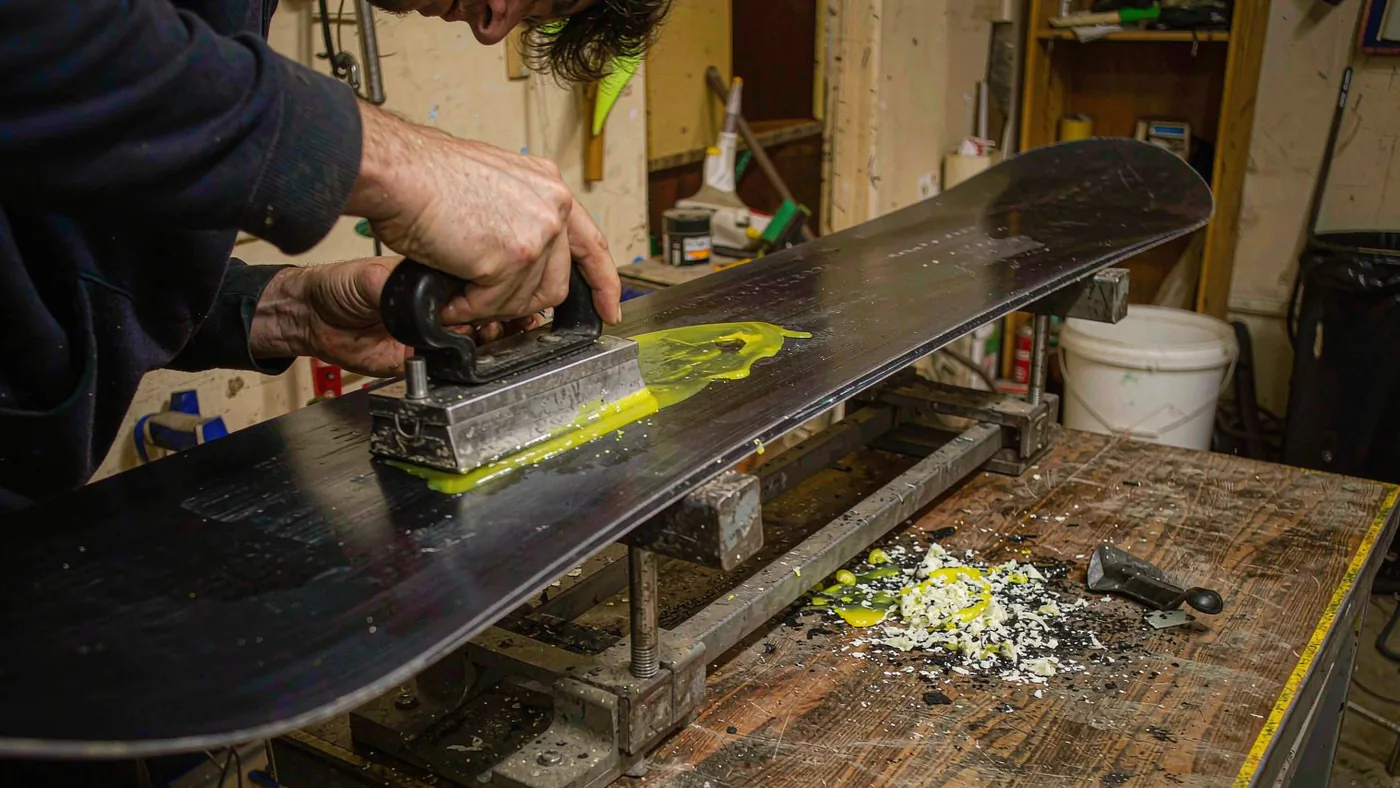
Hot waxing is the method worth learning. Clean the base, melt wax onto it with an iron set low enough that the wax melts without smoking, spread it with the iron, then let the board cool completely before scraping. Scrape with a plastic scraper, then brush along the base in the direction of travel to open up the structure. The mistake almost everyone makes is scraping too soon: warm wax smears rather than scrapes out, and the base ends up glazed and slow.
Do not overheat the base. An iron held in one place, or set too hot, burns the base and leaves a permanent shiny patch that never holds wax properly again. Keep the iron moving and use the lowest setting that melts the wax. Rub-on and liquid waxes are a legitimate shortcut for a quick mid-trip refresh, but they do not last and they do little for base condition. Paying a shop makes sense if you do not want the equipment or the base needs a grind or a repair.
Remove rust before you touch the edge with a file, or you will drag rust into the steel. Take it off with a gummi stone or a fine diamond stone first. Deal with burrs — the raised folds of metal left by rock hits — in the same way, because a burr catches unpredictably and will not take an edge until it is flat.
Sharpen with a guide. Files and stones have to be held at the correct angle or you round the edge off rather than giving it one, and a simple guide takes the guesswork out. Most snowboards leave the factory with a base bevel of about one degree and a side bevel of about two, and you should follow whatever your board was built with. A small amount of detuning at the very tip and tail can help a park board catch less on rails, but detuning under your feet or through the sidecut costs you grip on firm snow.
The maintenance table
| Task | How often | Time | What you need | Hand it to a shop if |
|---|---|---|---|---|
| Hot wax | Every four to five days of riding | 30–40 minutes | Iron, wax, scraper, brush | You would rather not buy the kit |
| Quick wax top-up | Mid-trip, when the board goes slow | 5 minutes | Rub-on or liquid wax | Never |
| Wipe and dry base and edges | After every day | 2 minutes | A cloth | Never |
| Remove rust and burrs | Start of season, and after rock damage | 10 minutes | Gummi or diamond stone | The edge is bent, not just burred |
| Sharpen edges | Every ten to fifteen days, or when grip drops | 20 minutes | Edge guide, file or stone | You are unsure of the bevel angles |
| Base repair | When a gouge reaches the core | 15 minutes per gouge | P-Tex and a lighter | The gouge is deep or near the edge |
| Base grind | Rarely, when the base is glazed or uneven | Shop visit | Not worth owning at home | Always |
Editorial guidance on routine maintenance, last reviewed 28 September 2026. Timings are rough; a first attempt at hot waxing takes longer than the second.
The two-minute daily routine is the most valuable habit in this article and it costs nothing. At the end of the day, before the board goes in the bag, wipe the base and edges dry with a cloth. Snow and moisture left against steel overnight is what produces the rust line. In a chalet, stand the board somewhere it can drain rather than leaving it in a wet bag in a warm room. And do not lean the board against a wall on its tip — that is how tips get crushed and how a base gets bent at the end.
Summer storage
Put the board away properly and it will come out in November almost as you left it.
Clean the base and edges thoroughly, dry everything, then wax the board heavily and do not scrape it. That thick layer of wax stops the base oxidising over the summer, and you scrape it off in the autumn along with whatever dirt it has collected.
Store the board flat, or hanging vertically by the tail, somewhere dry and out of direct sunlight with a reasonably stable temperature. A hot loft is not ideal and neither is a damp garage floor. Leave the bindings mounted or take them off, but loosen the straps a little before putting everything away. Then leave it alone: the main risk over summer is damp and heat, not time.
Verdict
If you ride three or four days a year, pay a shop for one hot wax at the start of the season and top it up with a rub-on wax during your trip. Buying an iron, a scraper, a brush and a set of stones to use twice a year will cost more than paying someone else. Riders doing more than a couple of weeks a season are the ones who benefit from learning the full routine.
Frequently asked questions
How often should I wax my snowboard?
As a rough guide, every four to five days of riding, and more often in warm, wet or abrasive spring snow, which strips wax quickly. If the base looks pale and dry near the edges, or the board feels slow on flat run-outs, it is time to wax.
Can I wax my snowboard with a normal household iron?
A dedicated wax iron is worth the small outlay because it holds a stable temperature, but a normal iron with no steam and a low setting can be used with care. Never use steam, never set it too hot, and keep it moving. Wax that smokes means the iron is too hot and the base is at risk.
How do I stop my snowboard edges rusting?
Dry them. Almost all edge rust comes from moisture left against the steel, usually in a board bag overnight or over the summer. Wipe the base and edges at the end of every day, store the board dry and out of a damp garage, and put a thick protective layer of unscraped wax on before summer storage.
Do I need to detune my snowboard edges?
Usually no. A small amount of detuning at the very tip and tail can help a park board catch less on rails, but detuning under your feet or through the sidecut will cost you edge hold on firm snow. If you ride mostly piste, keep the edges sharp and leave them alone.
How should I store my snowboard over summer?
Clean and dry it, apply a thick layer of wax and leave it unscraped, then store it flat or hanging by the tail in a dry place with a stable temperature. Avoid damp garages, hot lofts, direct sunlight and anywhere it will lean on its tip for months. Loosen the binding straps slightly first.
Where to go next
If you would rather pay someone else, the buying guide explains how specialist shops handle servicing and setup. Riders who want to do the whole job themselves should read the at-home waxing and tuning guide alongside this one.
For everything else before a trip, see the pre-trip checklist. If your edges are shot because the board is worn out rather than neglected, the new vs used guide and the budget guide will help you decide whether it is worth replacing. More advice sits in the buying-guides archive.