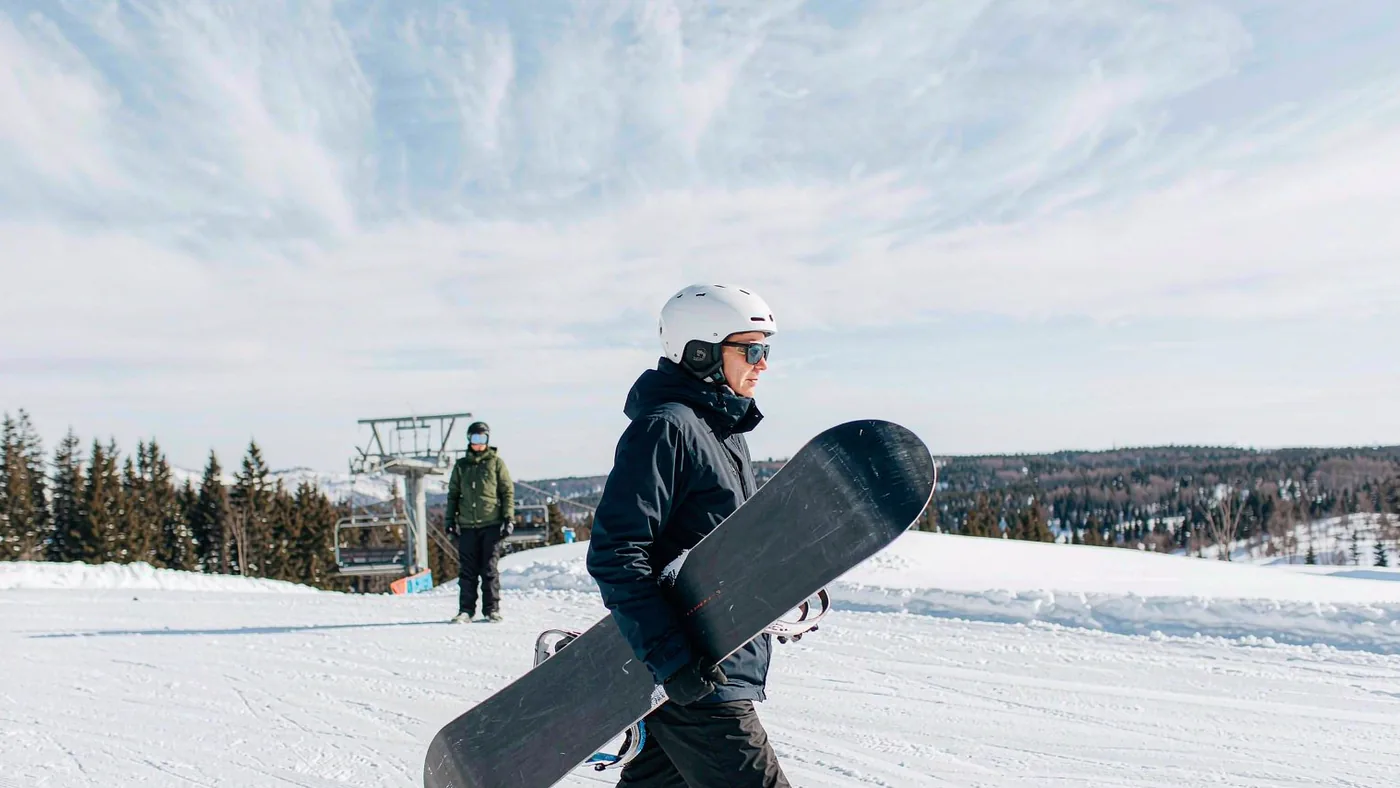
You are standing in a resort car park with the board in your right hand, the tail resting on the tarmac, and you have just worked out that the lift you want is a two hundred metre walk uphill. Over the next ten minutes you will drag the tail across the grit, swap hands every thirty seconds, catch the board on somebody's skis, and arrive at the bottom station with your arm already tired before your day has started.
Nobody teaches this. Instructors teach standing, turning and stopping, and then send riders off to carry a metre and a half of board around a resort for a week. Riders who get it wrong spend the week with a sore shoulder, gouged gloves and a tail full of gravel. Riders who get it right never think about it.
The good news is that there are only four or five grips worth knowing, and the difference between them is which part of your body carries the load.
What actually matters
Carry by the toe edge, with the board under your arm. The board goes under one arm with the toe edge — the side away from your body — resting in your palm, the base facing away from you and the tail pointing down behind. Your hand grips the toe edge at roughly the point of balance, which for most boards is near the front binding, and your forearm sits underneath taking the weight against the bone rather than through the wrist.
Carry it with your downwind hand. Walking across an exposed resort is much easier if the board is on the side away from the wind, because a metre and a half of board is a sail. On a windy day, swap sides at every stop.
Use both hands for stairs, wind and crowds. The single-arm carry is fine on the flat. On stairs, on steeps, in a busy lift queue and in strong wind, take the board across your body with your front hand on the nose and your back hand on the tail, holding it horizontally across your thighs. It looks less relaxed and it is far easier on one shoulder.
Base faces away from your body and away from other people. Carrying base-out means the edges are turned towards you, which protects everybody else's skis, jackets and shins from a two-millimetre steel rail. It sounds trivial until you have watched a rider walk past a queue with the edge outermost.
The grips, one by one
The under-arm toe-edge carry. The default. Board under one arm, toe edge in the palm, base out, tail trailing behind. Your free hand stays available for a lift pass, a gate or a glove. Use it on flat ground and in queues.
The two-handed across-body carry. Both hands on the board, roughly at the nose and the tail, held horizontally across your thighs. Use it on stairs, on steep paths, in strong wind, and whenever the single-arm version starts to hurt.
The over-the-shoulder carry. Board up on one shoulder, gripping the toe edge with the same-side hand. This is a common instructor and lift-operator grip and it works well on long flat walks, because the load goes through the shoulder rather than hanging from the arm. It is a poor choice in a crowd, because the board sweeps at head height behind you.
The two-board carry. Two boards go together base to base, nose to tail, gripped at the point of balance with one hand, edges outermost. It is heavy and unbalanced and it works for a short walk to a lift. For anything longer, carry them one at a time or use a bag.
Carrying with a pack. Put the pack on first, then pick up the board. Keep the pack straps tight so the load does not shift as you walk. Putting a pack on over a board already in your hand is how people drop a board on a boot.
| Grip | Where the load goes | Best used for | Weaker at | Suits |
|---|---|---|---|---|
| Under-arm toe edge | Forearm against the bone | Flat walks and lift queues | Wind, stairs and long distances | Most riders, most of the time |
| Two-handed across the body | Both arms and the torso | Stairs, steeps, strong wind, crowds | Getting through a turnstile | Anybody on a long or awkward walk |
| Over the shoulder | Shoulder | Long flat walks | Crowded areas at head height | Lift operators, instructors, long approaches |
| Two boards in one hand | One arm, badly | A short walk from the car | Everything beyond fifty metres | Riders arriving with a partner's board |
Published specifications, last checked 28 September 2026. The assessment of which grip suits which situation is editorial judgement about load and safety, not the result of any measured study.
Habits that wreck shoulders and gloves
Dragging the tail. The worst habit and the most common. Dragging grinds the corner of your base and edge into gravel, wears the base material away, and loads your shoulder unevenly as you compensate. It ruins the tail of a board within a season.
Carrying by the binding. The natural thing to grab, and a lever acting on the inserts at a bad angle. A highback is also the component most likely to fail in cold weather. If you must hold something other than the edge, hold the toe edge near the binding rather than the binding itself.
Carrying gloves in your hand, or no gloves at all. The palm is the part of a glove that wears out first, and a board carried bare-handed scuffs it.
When you should not be carrying it at all
There is a point on every mountain where walking with the board stops being the sensible option, and most beginners push past it out of pride.
Flat sections and long traverses between lifts, gentle uphill links, a cat track back to the base: these are places to put the board on and skate, not to walk. Skating is gliding on the front foot and pushing with the free one, and it is why lift exits and long flats are worth practising one-footed. Even a slow skate beats a three-hundred metre walk in boots.
The exception is ice. Skating on a flat section of polished ice with one foot loose is genuinely risky, and walking slowly in the two-handed grip is the safer choice. Take the extra two minutes.
At the end of the day the same principle applies in reverse. Take the board off before you get to the boot room, not inside it. A board carried into a warm room brings in snow, melts it on the floor and picks up grit and salt on the way in.
If you have a shoulder injury or a history of shoulder problems, do not carry a snowboard under one arm and hope for the best. Use the two-handed across-body grip for every walk, however short, and for anything over a few hundred metres use a board bag that goes over both shoulders. A bag also protects the base from the grit that does real damage to a base, which makes it a sensible purchase for anybody walking from a car park every morning rather than an indulgence.
Frequently asked questions
Which hand should I carry a snowboard in?
Use the hand on the side away from the wind, because the board acts as a sail on any exposed walk. On a calm day it is largely a matter of comfort, and most riders find the leading hand natural. Swap sides before the arm gets tired rather than after.
How far can I carry a board before it becomes a problem?
The single-arm carry becomes uncomfortable for most riders after two hundred to three hundred metres, and dragging the tail over that distance will visibly mark a base. For anything longer, switch to the two-handed grip, use a bag, or put the board on and skate.
Should I carry my board by the binding?
No. Carrying by a binding or a highback puts the load through the screws and the plastic at a bad angle, and highbacks are among the parts most likely to fail in cold weather. Hold the toe edge just behind the front binding instead.
Is it bad to drag the tail along the ground?
Yes. Dragging wears the base material and the tail edge, and gravel in a car park is the surface that does the damage fastest. It also loads your shoulder unevenly, because you are half lifting and half pulling a board that is catching on the ground.
Where to go next
For the lift side of the same journey, read how to get off a chairlift without falling and how to ride surface lifts and T-bars, both of which depend on holding a straight glide with one foot loose.
If you are travelling with the board, how to fly with a snowboard covers packing and airlines, and our backpack buying guide covers what to carry for a day out. There is more in the advice section.