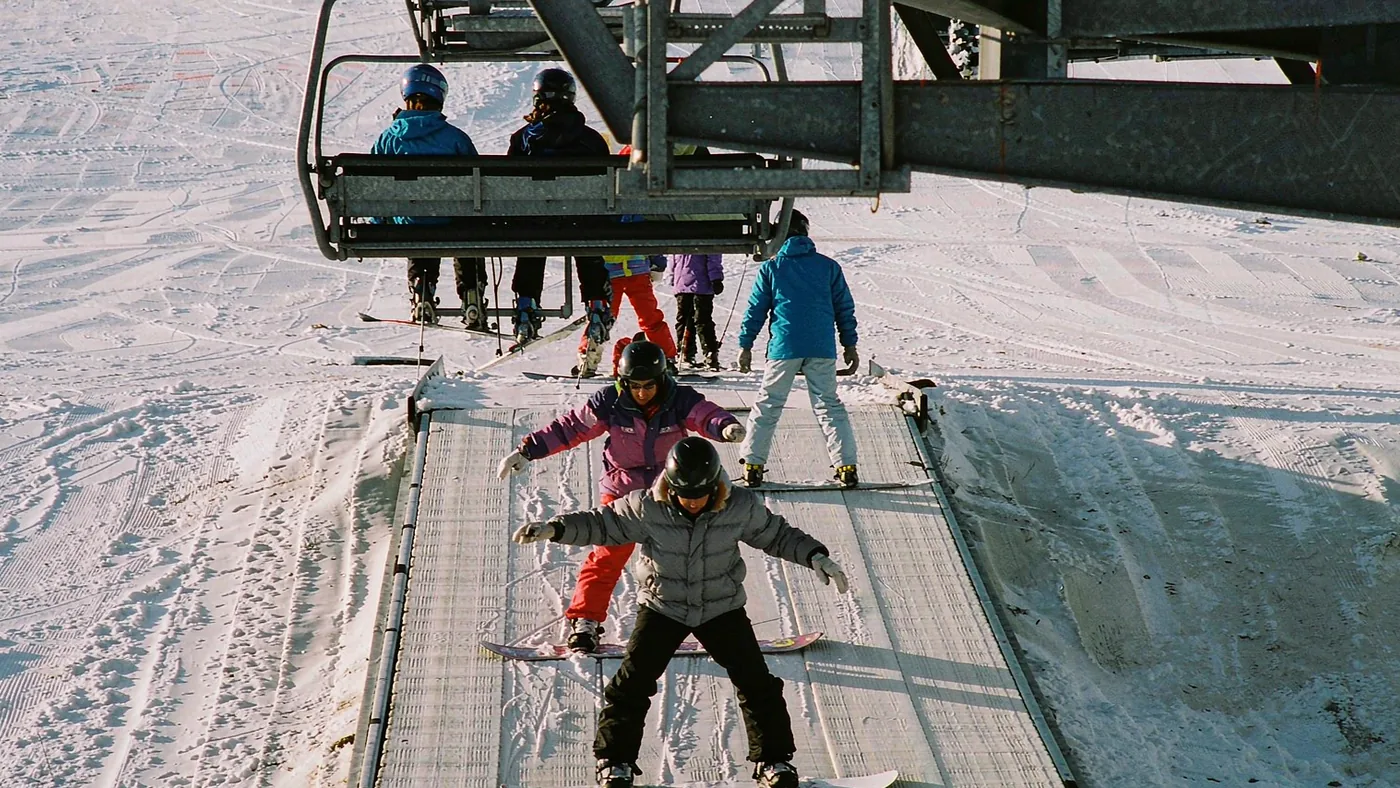
The chair passes the last pylon, the safety bar goes up, and the two people beside you stand, shift their weight and glide away down the ramp as though the whole thing were nothing. You have about eight seconds to do the same. Your board is lying across the fall line, your back foot is out of the binding, and the ten metres in front of you look like a conveyor belt tipping into a crowd of waiting skiers.
Falling off a chairlift is the most common source of beginner fear, and the least rational one. The exit ramp is built by people who want you to succeed: it slopes gently away from the chair, it is groomed flat, and the chair is already carrying you forward. You are not being asked to do anything clever.
What follows is the exit from the last fifty metres of the ride to the moment you are clear of the ramp, and the honest version of what to do on the days it still goes wrong.
What actually matters
The ramp slopes away from the chair, not across it. Beginners arrive at the top expecting to have to steer. You do not. The ramp is a short, straight, gentle decline, and the entire job is to travel down it in a straight line until you are far enough away from the queue behind you.
A flat base is the whole trick. Put any edge on the snow and it will catch the instant your full weight arrives. The board needs to lie flat, nose pointing down the ramp, with the free boot pressed onto it rather than dangling. That means resisting the urge to nudge the nose sideways as you stand.
Weight goes forward, not back. Standing up from a seated position pulls your centre of mass backwards, which is precisely the wrong direction, and almost every backwards fall on a ramp comes from that one instinct. The counter is deliberate: as you stand, put your front hand flat over the nose of the board and press down on it.
Commit at the unload mark, not before and not after. Every ramp has a mark — a painted line, a sign, or the lift operator's raised hand — a couple of metres before the end. Standing early puts you on the ramp with the chair still moving underneath you; standing late means the chair tips you forward.
The last fifty metres
Most of the exit is decided before the chair reaches the ramp. Sit forward rather than slumped against the backrest, both feet flat on the footrest, back foot out of the binding and set on the stomp pad or pressed against the back of the rear binding. Straighten the board so it points down the ramp, and raise the safety bar as soon as the signs tell you to rather than at the last second.
If this is your first time on a chair, or you are riding with young children, say so to the lift operator at the bottom. They can slow the lift for your ride, and they would far rather do that than stop it while you are lying on the ramp.
The exit, step by step
- Watch for the unload mark — a painted line, a sign or the operator's hand, usually two or three metres before the end.
- Straighten the board so the nose points down the ramp and the base is flat.
- Put your front hand over the nose, fingers spread, pressing lightly. This stops the nose lifting and gives you something to push against.
- As the chair reaches the mark, stand up. Not push off, not hop — stand. The chair's forward motion provides the speed.
- Glide straight. Eyes on a point at the bottom of the ramp. Do not turn, do not edge, do not try to slow down.
- Clear the ramp before you stop, then step to one side and, if you are carrying on, put your back foot into the binding.
The three ways it goes wrong
Almost every fall at the top of a lift is a version of one of these. Riders who diagnose their own fall correctly usually stop falling within two or three rides.
| What you did | What it looks like | Why it happens | The fix |
|---|---|---|---|
| Looked down | Board wavers, edge catches, you sit down halfway | You steer where you look, and looking at the nose pulls your weight forward and then back | Pick a point at the bottom of the ramp and hold your eyes on it |
| Turned too early | Board goes sideways, you catch an edge and land hard | Standing feels unstable, so the instinct is to turn out of the fall line before you have speed | Count to three after standing, then do nothing at all with your feet |
| Leaned back | Nose lifts, you end up on the tail and then on your backside | Standing up from a seated position pulls your weight backwards | Front hand over the nose and press down as you stand |
Published specifications, last checked 28 September 2026. The diagnoses and fixes are editorial judgement drawn from what beginner instructors describe most often, not measured results.
When you do fall
You will fall off a lift at some point, and the fall itself is not the problem. What matters is the ten seconds afterwards. Fall forwards if you have any choice — onto your hands or your knees — rather than backwards onto your tailbone.
Do not sit on the ramp. The operator will have seen you and stopped the lift, and the next chair is on its way. Get up, get clear of the exit line, and fix your bindings twenty metres away in a flat space where nobody is arriving behind you. Do not try to save a wobble by grabbing the chair: riders who do that are the ones who get dragged or twisted.
Verdict
If you have fallen off the same lift three times in a row, stop repeating the ride and change the situation instead. Ask the lift operator to slow the lift for your next attempt, spend twenty minutes practising one-footed glides on the flat, or take a chair with a longer, flatter ramp for the rest of the morning. A fourth identical attempt teaches you nothing and starts to build a genuine fear of lifts, which is far harder to undo than an awkward exit.
Frequently asked questions
Do I keep my back foot in the binding on a chairlift?
On most chairs you ride with the back foot out, resting on the stomp pad or against the rear binding, because the exit is shared with skiers and you need to step away. Take your lead from the signs at the bottom station and from the lift operator.
How long does the exit actually last?
The run-out is usually between eight and fifteen metres, which at typical lift speed gives you roughly four to eight seconds from standing to being clear. That is not long, which is why the sequence has to be decided before the chair reaches the mark.
Should I raise the safety bar myself?
Yes, and early. Raise it as soon as the signs indicate, so your hands are free to straighten the board and press onto the nose. Leaving the bar down until the last moment means doing two jobs in the final two seconds.
What if I fall right at the top with people behind me?
The operator will stop the lift, so nobody arrives on top of you. Get yourself and the board off the exit line as fast as you can, even by shuffling on your backside, then step aside and let the operator restart.
Is a chairlift harder than a surface lift?
They are different skills. A chair asks you to hold a straight, flat, one-footed glide for a few seconds. A drag lift asks the same thing for a minute or more while pulling you uphill, which is why most beginners find the chair easier despite the height.
Where to go next
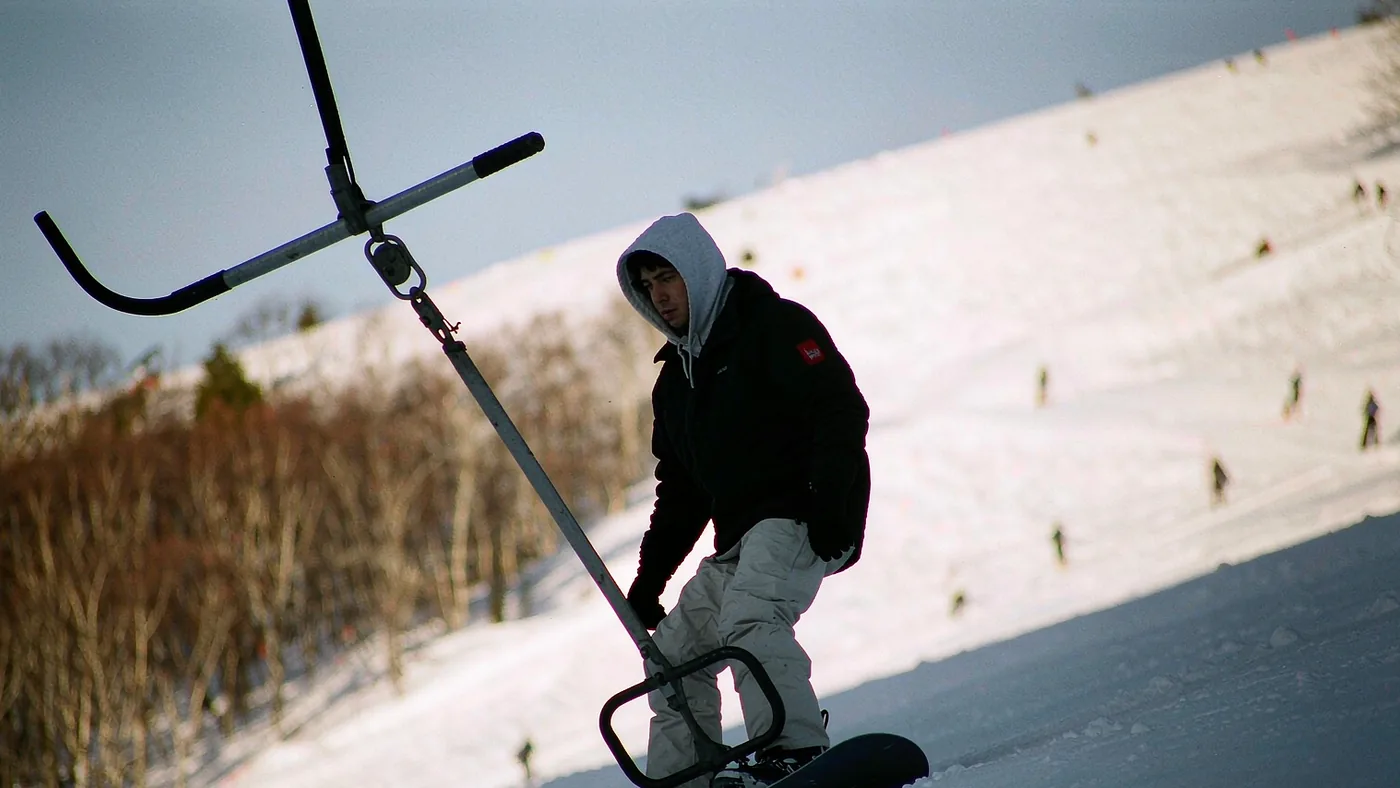
If your resort is served by drag lifts, read how to ride surface lifts and T-bars before you meet one. The other beginner habit worth fixing early is how to carry a snowboard between the lift and the queue.
For the wider picture of a first week, see first season snowboarding, and how to set up snowboard bindings covers the angles and strap tension that make a one-footed glide easier. There is more in the advice section.