Two boards, two spec sheets, both marked with the same flex number, and yet one of them folds under a rider of 55kg while the other barely moves. That situation is not a manufacturing error. The number describes where a board sits inside one brand's own range. It is not a measurement against any shared standard.
That matters more than most buying advice admits. Flex is the most consequential specification on a snowboard, because it decides how the board responds to the force you put into it. A board too soft folds when you push it; a board too stiff never bends enough to give you what you paid for. Both feel like the mountain fighting back.
So the useful skill is not memorising flex scales. It is knowing what flex describes, what it changes, and how to compare two boards without the number at all.
What flex actually describes
Longitudinal flex. This is what most people mean by flex: how much the board bends along its length, tip to tail. It governs pressing and buttering, how the board loads before an ollie, and how much it deforms to absorb rough snow rather than sending it up into your legs. A soft board bends easily under low load; a stiff one needs real force.
Torsional flex. This is how much the board twists, with the nose and tail rotating relative to each other. Torsional stiffness is what keeps the whole edge engaged when you roll the board over and load it, because a board that twists lets the front and rear of the edge do different things. It is the property most closely tied to edge hold on firm snow, and it is almost never printed anywhere.
Flex varies along the board. A deck can be stiff between the bindings and softer in the tips. When a brand says "medium", it usually means the central platform.
Why the numbers don't travel between brands
Each brand writes its own scale. Some use one to five, some one to ten, some words. A brand's "7" is defined only against its own "4", and nothing obliges it to line up with a competitor's "7". Two manufacturers can both build a genuinely firm medium-flex board and publish different numbers for it, entirely honestly.
The reference rider differs. A scale is calibrated against an idea of an average rider, and that idea varies. A board rated medium by a brand thinking about a 90kg rider is a different physical object from one rated medium by a brand thinking about a 65kg rider.
Length changes everything. The same model in a 148 and a 165 will not flex the same way under the same rider, because a longer board gives your weight more leverage. A 150cm "6" and a 162cm "6" are not the same experience, and neither is a 162 "6" under a 60kg rider and under an 85kg one.
Profile interacts with flex. A rocker-dominant board feels looser than a cambered board of the same stiffness, because the contact points are already lifted. A tapered shape feels different again at the tail. Flex is one variable among several, and reading it alone will mislead you.
What flex does to your riding
Soft flex. Easy to press and butter, forgiving of a mistimed turn, comfortable at low speed. It folds under a heavy or aggressive rider at speed, gives less support on landing, and delivers less energy out of a turn.
Medium flex. The compromise most riders should be buying. Stable enough to hold an edge under pressure, forgiving enough that a mistake is not a disaster, and versatile across the whole mountain. It is also the flex most likely to stay useful as you improve.
Stiff flex. Holds a line at speed, resists twisting, engages the whole edge at once and supports a landing well. It demands commitment, is uncomfortable at low speed, and will not press or butter without a fight. A rider who cannot load it gets a wooden board rather than a precise one.
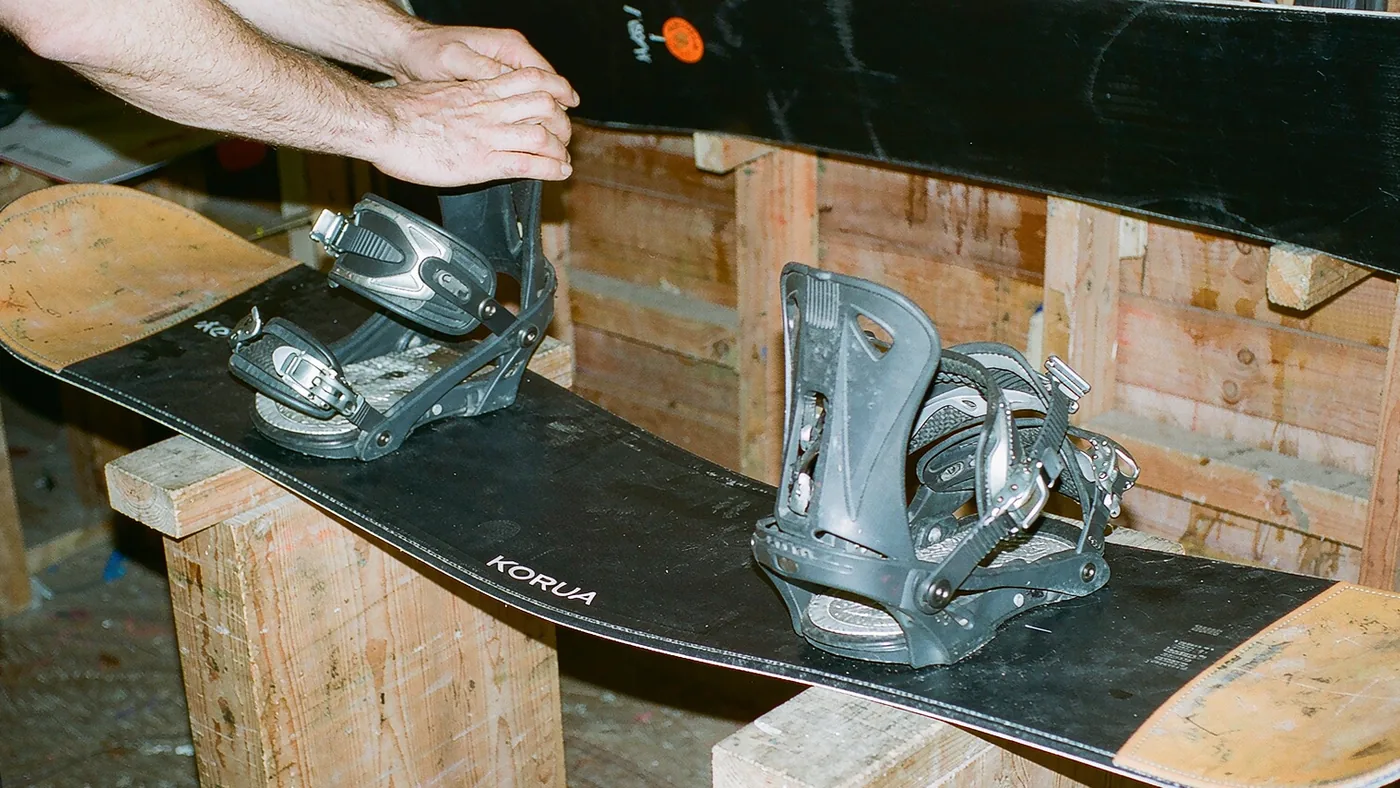
Match it to the rest of your setup. A very soft boot on a stiff board delivers a vague, delayed input, and a stiff boot overwhelms a soft board. Bindings should sit in the same general range as both.
Two decks at opposite poles
The clearest way to see what flex does is to look at two boards using it for different purposes.
The board most other all-mountain decks are judged against. Predictable, grippy on hardpack, and it stays composed when you push it harder than you meant to.
Best for
- Riders who want one board for the whole mountain
- Improvers moving up from a beginner deck
- Anyone riding a lot of European hardpack
Worth skipping if
- Park riders who want a soft, pressable twin
- Riders on a tight budget
- Profile
- Traditional camber
- Shape
- Directional twin
- Flex bias
- Medium-stiff
- Intended terrain
- All-mountain
Strengths
- Very predictable edge-to-edge behaviour
- Holds an edge on scraped European pistes
- Wide size run including wider waist options
Trade-offs
- Camber profile punishes lazy technique in powder
- Priced at the premium end for what it is
Specifications reflect published manufacturer information, last checked 2026-09-28. We have not laboratory-tested this product; the assessment above is editorial, based on the published design and the rider profile it targets. How we review gear.
A short, wide, tapered shape that turns a normal powder day into a good one. It is a specialist, and it is worth owning only if you get real powder days.
Best for
- Riders who get regular deep-snow days
- Anyone adding a powder-specific deck to a quiver
Worth skipping if
- One-board riders
- Anyone riding mostly groomed pistes
- Profile
- Rocker-dominant with camber underfoot
- Shape
- Tapered directional
- Flex bias
- Medium
- Intended terrain
- Freeride / powder
Strengths
- Outstanding float for its length
- Turns quickly in tight trees
- Fast, durable base
Trade-offs
- Poor on hardpack compared with a camber deck
- Only makes sense as a second board
Specifications reflect published manufacturer information, last checked 2026-09-28. We have not laboratory-tested this product; the assessment above is editorial, based on the published design and the rider profile it targets. How we review gear.
How they compare
| Board | Published flex bias | Profile | Shape | What the flex is tuned for | Best suited to |
|---|---|---|---|---|---|
| Burton Custom Camber | Medium-stiff | Traditional camber | Directional twin | Holding a line at speed on firm snow | Confident riders who ride mostly groomers |
| Jones Hovercraft | Medium | Rocker-dominant with camber underfoot | Tapered directional | Turning quickly in soft snow and trees | Riders who get regular deep days |
Published specifications, last checked 28 September 2026. What the flex is tuned for is an editorial judgement about the design, not a measured result.
Both sit in the middle of the range and behave nothing alike. The Custom's medium-stiff flex presses the edge into hardpack and holds it under load. The Hovercraft's medium flex lets a rockered, tapered shape turn quickly in soft snow. Similar word, opposite jobs.
How to compare two boards without the number
Read the weight range first. This is the most useful figure a manufacturer publishes and the one most often ignored. If you sit in the lower half of a board's weight band it will feel stiffer than the description suggests; above the band it will feel softer. Aim for the middle.
Compare effective edge, not length. Two boards of the same length can differ in how much edge actually touches the snow, and that changes how a given flex feels underfoot on firm terrain.
Look at profile and shape together. Camber and taper both change the sensation of flex before you load the board. A rocker-dominant tapered deck feels looser than a cambered symmetric one of identical stiffness.
Who should ignore flex ratings entirely
Absolute beginners. Buy for forgiveness, not for a number. A soft board with a relaxed profile will get you linking turns faster regardless of how its flex is described.
Riders buying their second board on a budget. Your boots and your edge tune will change your riding more than one flex step in either direction. Fix those first.
Riders buying a specialist board. If you are buying a powder deck or a park deck, shape and profile are doing most of the work. Flex matters, but it is not the first thing to compare.
Verdict
The Burton Custom Camber and the Jones Hovercraft are both good boards and both sit mid-range on flex, yet they are built for completely different days — which is exactly why the number should not drive your shortlist. If you are buying your first or second board, work from the recommended weight range, the profile and the terrain the board was designed for. Only once you have ridden enough to know how you like a board to feel is the flex descriptor worth much at all.
Frequently asked questions
Why do two snowboards with the same flex rating feel different?
Because each brand defines its scale internally, and because flex interacts with profile, shape and construction. A medium rocker-dominant tapered board feels looser than a medium cambered symmetric one, and two lengths of the same model will not flex identically under the same rider.
What flex rating should a beginner snowboard have?
Soft to medium, matched to your weight rather than to a number. Riders around 55kg should be in the lower half of a board's recommended weight band; heavier riders should look for medium. A beginner on a stiff deck spends the season fighting the board instead of learning from it.
Does board length change how a snowboard flexes?
Yes, noticeably. A longer board gives your weight more leverage, so it bends more easily under the same rider than a shorter one, and a 165 will feel softer than a 150 of the same model and stated flex. That is why the weight range differs for each length.
What is torsional flex and does it matter?
Torsional flex is how much the board twists along its length, with nose and tail rotating relative to each other. It matters a great deal on firm snow, because a board that twists lets the front and rear of the edge behave differently when you load it. It is rarely published, which is one more reason the flex number is incomplete.
Should my binding flex match my snowboard flex?
Roughly, yes. A very soft binding on a stiff board delivers a vague, delayed input, and a stiff binding overwhelms a soft board. Keep board, binding and boot within one general range of each other, and treat a mismatch as the likely cause when a board feels dead.
Where to go next
If you want to read the numbers properly, the how to read a snowboard spec sheet guide walks through every figure a manufacturer publishes, and the camber profiles explained article covers the variable that interacts most with flex.
Once you know what you are looking for, the best all-mountain snowboards round-up is the broadest comparison, the camber vs rocker vs flat piece sets the three families side by side, and the snowboard size chart turns the weight range question into an actual length. More in the boards archive.