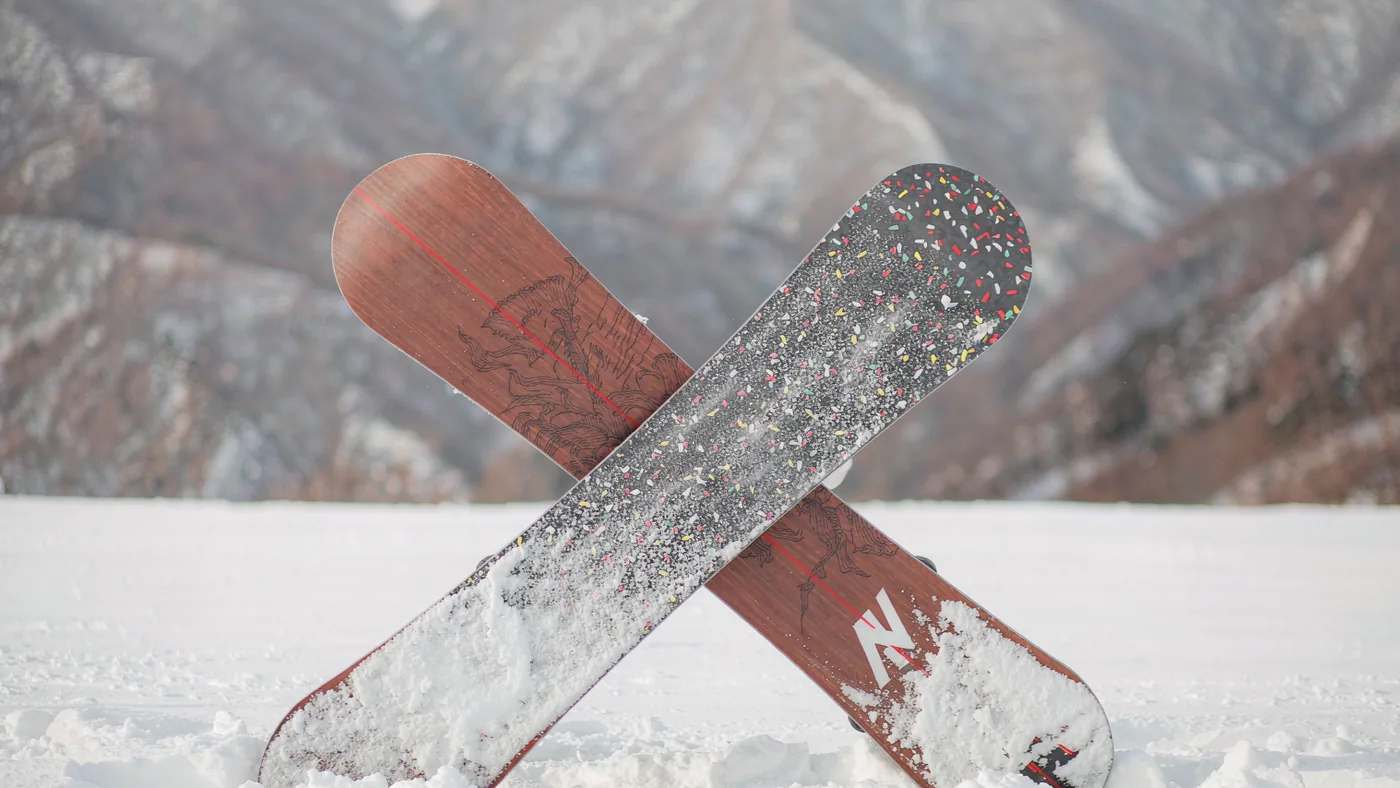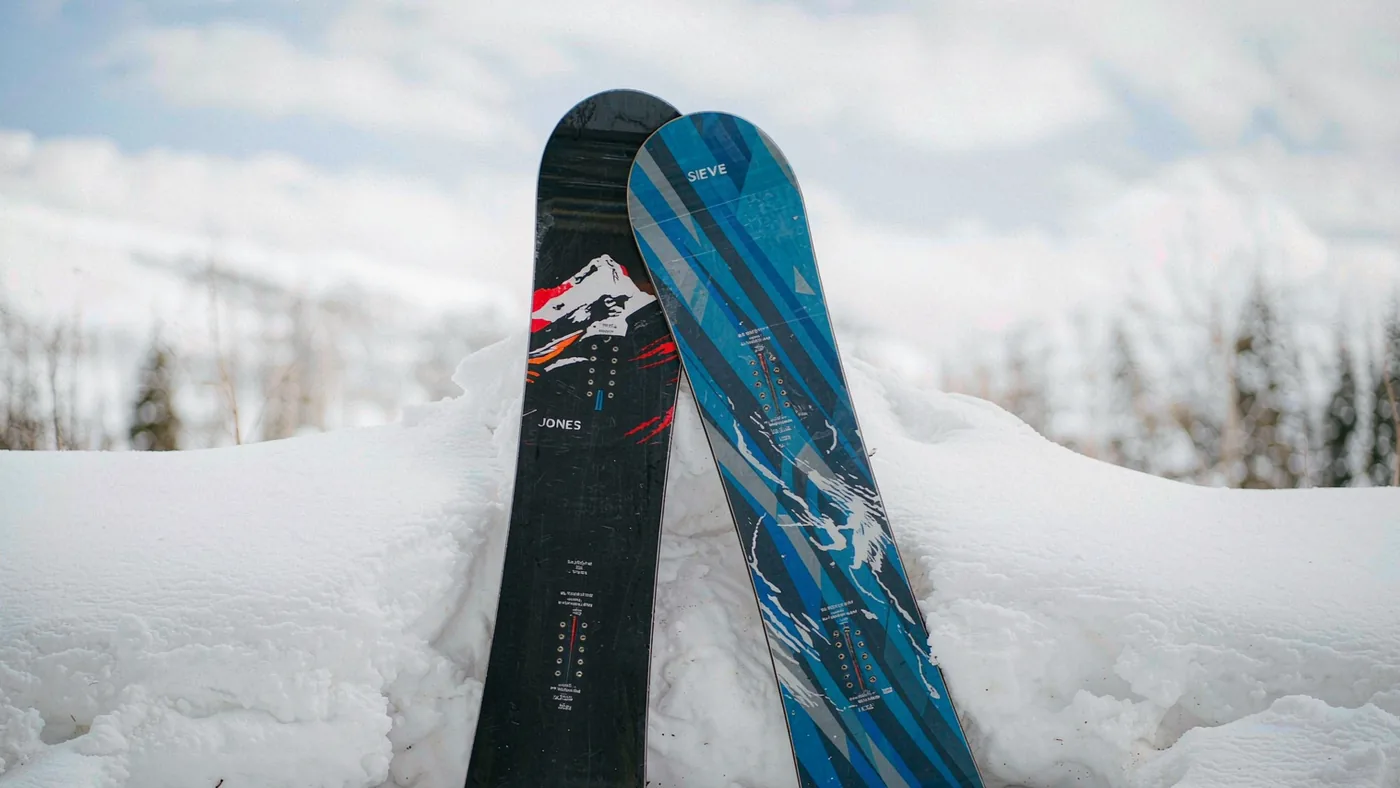
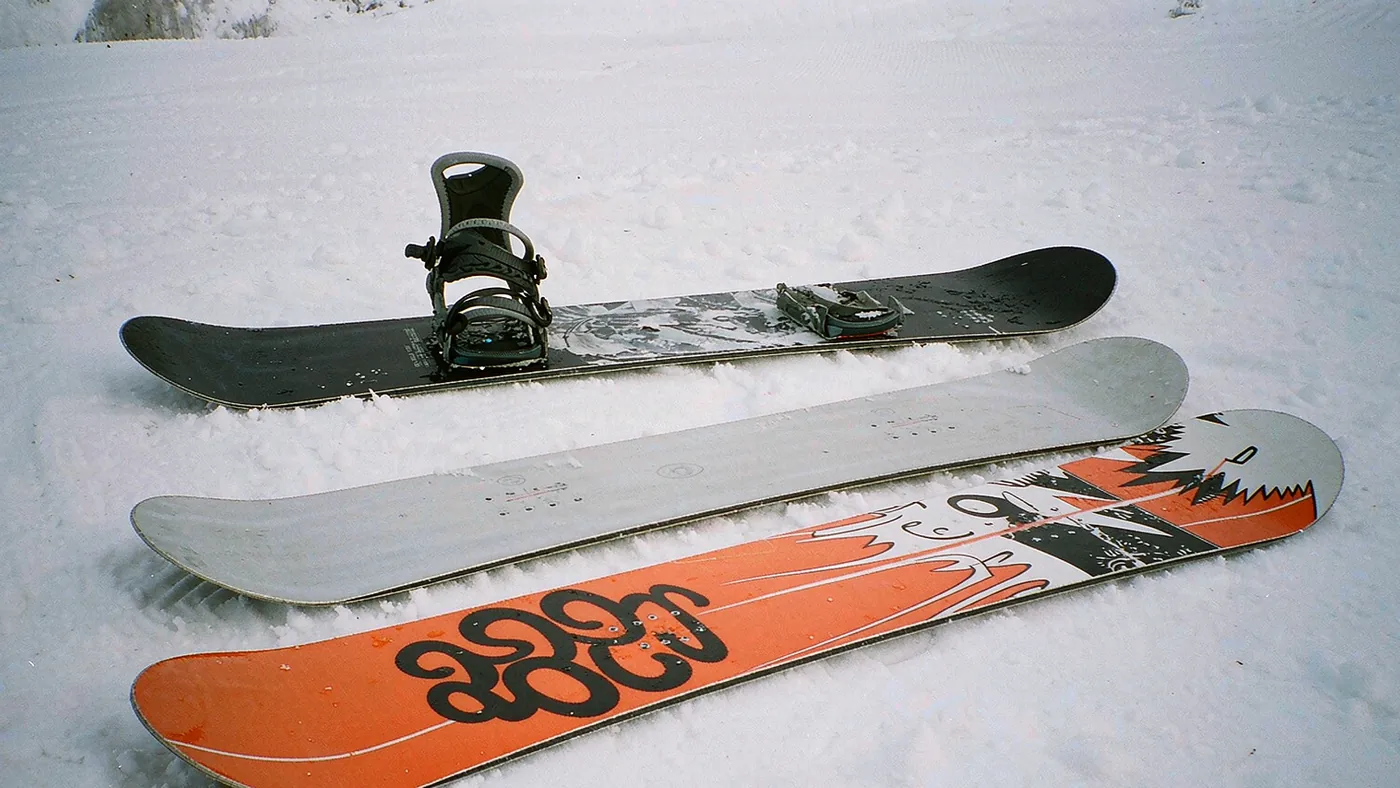
In a shop on the edge of Manchester on a wet Saturday in October, two boards are lying on the carpet and someone is pressing down hard on the middle of each one. The first arches up under the hand and pushes back. The second has no arch at all — its nose and tail sit clear of the carpet and the middle rests flat on it.
Camber, rocker and flat are not three steps from bad to good. They describe where the base touches the snow, and each trades something you want for something else you also want. The short version: if most of your days are on European pistes that have been groomed, scraped and refrozen overnight, buy camber, either traditional or underfoot in a hybrid. If you are in your first week and still catching edges, buy flat or rocker-tipped. If you genuinely get three or more soft-snow days a season, buy rocker as well, and treat it as a second board rather than your only one.
What actually matters
Where the contact points sit. On a cambered board only the tip and tail touch the floor, and your weight flattens the arch, pressing the running edge into the snow along its length. Rocker reverses that: the middle drops, the tips lift, and the contact points move in under your feet. Flat does neither and touches everywhere at once.
What happens when you tip it over. Camber engages progressively and stores energy as it bends, which is why it feels lively out of a turn and holds on firm snow. Rocker needs a larger rotation before the edge bites, so it feels vague at low angles and forgiving while it is flat. Flat sits between the two and does neither badly.
What it does at the speed you actually ride. A beginner travels at the kind of speed where camber's stored energy mostly just makes the board run down the fall line. Rocker and flat behave better at those speeds and then cost you grip the moment you start going quickly.
What the label hides. Almost nothing is labelled simply camber or rocker. Hybrid and camrock cover everything between, and two boards with the same label can behave nothing alike. What matters is how deep the camber section is, how far the rocker reaches towards the bindings, and where the transition sits.
The picks
The board most other all-mountain decks are judged against. Predictable, grippy on hardpack, and it stays composed when you push it harder than you meant to.
Best for
- Riders who want one board for the whole mountain
- Improvers moving up from a beginner deck
- Anyone riding a lot of European hardpack
Worth skipping if
- Park riders who want a soft, pressable twin
- Riders on a tight budget
- Profile
- Traditional camber
- Shape
- Directional twin
- Flex bias
- Medium-stiff
- Intended terrain
- All-mountain
Strengths
- Very predictable edge-to-edge behaviour
- Holds an edge on scraped European pistes
- Wide size run including wider waist options
Trade-offs
- Camber profile punishes lazy technique in powder
- Priced at the premium end for what it is
Specifications reflect published manufacturer information, last checked 2026-09-28. We have not laboratory-tested this product; the assessment above is editorial, based on the published design and the rider profile it targets. How we review gear.
A short, wide, volume-shifted deck that rides like a much longer board but turns far quicker. The best option here if you fly with one board and want it to handle everything.
Best for
- Riders who want one travel board for all conditions
- Bigger-footed riders who need a wide waist
Worth skipping if
- Riders who want a traditional-feeling camber deck
- Dedicated park riders
- Profile
- Rocker-dominant hybrid
- Shape
- Tapered directional, volume shifted
- Flex bias
- Medium
- Intended terrain
- All-mountain / powder
Strengths
- Very short, very quick in tight terrain
- Floats far better than its length suggests
- One of the best single-board travel choices
Trade-offs
- Smaller-footed riders may find the waist too wide
- Not a carving-focused deck
Specifications reflect published manufacturer information, last checked 2026-09-28. We have not laboratory-tested this product; the assessment above is editorial, based on the published design and the rider profile it targets. How we review gear.
The lifted base edges make it unusually hard to catch, which is exactly what you want while learning park basics. It does give up a little grip on ice.
Best for
- Riders learning rails and boxes
- Anyone who wants a confidence-boosting freestyle deck
Worth skipping if
- Icy-morning piste riding
- Riders who want a traditional, locked-in feel
- Profile
- Camrock with raised base edges
- Shape
- True twin
- Flex bias
- Medium-soft
- Intended terrain
- Freestyle
Strengths
- Notably forgiving on landings and flats
- Builds park confidence quickly
- Holds up through a full season of abuse
Trade-offs
- Less bite on genuinely icy slopes
- The 3D base shape takes a lap or two to adjust to
Specifications reflect published manufacturer information, last checked 2026-09-28. We have not laboratory-tested this product; the assessment above is editorial, based on the published design and the rider profile it targets. How we review gear.
How they compare
| Board as sold | Profile | Where the base sits | Best surface | Weakest surface | Low-speed forgiveness |
|---|---|---|---|---|---|
| Burton Custom Camber | Traditional camber | Arch between the contact points | Firm groomed piste | Deep snow | Low |
| Bataleon Evil Twin | Camrock, raised base edges | Raised edges towards tip and tail | Park and softened pistes | Icy mornings | High |
| Ride Warpig | Rocker-dominant hybrid | Contact close in under the feet | Soft snow and tight terrain | Fast hardpack | Very high |
| A typical flat-profile deck | Flat between the feet | Flat underfoot, tips slightly clear | Learning slopes and mixed snow | Both extremes | High |
Published specifications, last checked 28 September 2026. How forgiving each profile feels is an editorial judgement about the geometry rather than a measured result, and flex and length change it.
Flat is the profile nobody argues about
Flat gets a fraction of the attention the other two do, because there is no story in it. The base touches the floor along its length, the tip and tail are neither loaded nor lifted, and the board does what you ask without much personality either way. That makes it excellent for one rider in particular: someone in their first season who wants to stop catching edges and is not yet asking for grip or float at the extremes. What you give up is pop and bite on hard snow.
The decision rule: count the days you rode
Write down last season honestly, by surface. Most riders in the UK and northern Europe find the overwhelming majority of their days were on groomed, scraped or refrozen pistes. That list, not the trip you are planning, is what the board has to suit.
Mostly groomed and firm. Buy camber. A traditional camber deck is the most direct answer, and a hybrid with a deep camber zone underfoot keeps the grip with a friendlier nose.
Inside your first ten days on a board. Buy flat, or a hybrid with rocker in the tips. You will fall less, and falling less is how you build the mileage that makes everything else possible.
Three or more proper powder days a season. Buy a rocker-dominant deck as well, and keep the cambered board. Rocker earns its place in a quiver, rarely on its own.
One board, one flight a year. Buy the hybrid, not either extreme. The compromise is the point.
| Your season, honestly | Buy | Why |
|---|---|---|
| Firm pistes, one trip a year | Traditional or hybrid camber | Grip underfoot keeps the first run of the day upright |
| Refrozen pistes plus one soft day | Hybrid camber | Keeps the edge through the turn and floats better than its label |
| First week, learning to link turns | Flat or rocker-tipped | The tips lift instead of catching |
| Genuine deep-snow trips | Rocker-dominant as a second board | Float comes free rather than needing a sit-back stance |
Editorial guidance based on how each profile behaves in use and on published designs rather than measured performance.
What the compromise costs you
Width and length beat profile. A rocker-dominant deck too narrow for your boots drags on every turn, and a cambered board too long for your weight feels like a locked door. Fix the waist and the length before you argue about curve.
Flex changes the same profile twice. Stiff rocker is a float machine for a heavy, confident rider; soft rocker is a plaything. Neither is the beginner-friendly board the profile alone implies.
Edges decide the ice morning. A cambered board with a blunt edge skids on boilerplate, and a rocker-dominant board with a fresh, sharp edge holds better than you expect. The profile sets the potential and the tune decides how much you get.
Verdict
If your season is mostly refrozen pistes and you like to carry speed, do not make a heavily rockered board your single board — it will feel imprecise at the moment you need it to hold, and heavier riders feel that soonest. Do not buy traditional camber either if you are still catching edges, however much a friend insists it teaches better technique. Buy the profile that matches the surface you rode most last season, and hire the other one for the week you chase snow.
Frequently asked questions
Is camber or rocker better for a beginner?
Flat or rocker-tipped profiles are more forgiving, because the lifted tips are much harder to catch at the speeds a beginner rides. Camber grips better but punishes hesitant technique. A hybrid with camber under the feet and rocker in the tips gives enough grip to learn real turns without full camber's catchiness.
Why does my rockered board slide on icy pistes?
Because rocker lifts the tip and tail clear of the snow, so less edge touches when you tilt it over. On hard refrozen piste a rocker-dominant board drifts before it bites. On a 150cm deck that has lost contact at both ends there is very little running edge left to hold.
Can you carve on a flat-profile board?
Yes, within reason. A flat board holds a groomed turn, but it returns less energy than camber and feels vague once the surface hardens past a certain point. Riders who care about carving want camber underfoot, whether that is full camber or a camber zone between the bindings.
Does profile matter more than flex?
For grip and float, profile usually decides more; for how the board feels under your weight, flex does. A stiff deck of any profile fights a lighter rider, and a soft deck of any profile folds under a heavy one. Read the weight range for your length alongside the profile description.
How do I check a board's profile in a shop?
Put it on a flat floor and crouch so your eye is at floor level, looking along the base from the tail. If the middle arches and only the ends touch, that is camber. If the ends lift and the middle rests, that is rocker. If it lies flat, it is flat. Then press the middle and watch the tips react.
Where to go next
The camber profiles guide takes the same subject board by board. If you are choosing between two rides rather than two curves, see what separates all-mountain and freestyle decks, then settle length and width with the snowboard size chart.
Buying second-hand? Learn to inspect a used board first, because a deck whose camber has gone soft rides like a different profile entirely. More sits in the comparisons archive.