The board is leaning against a radiator in a hallway in Sheffield, and the advert said it had been ridden twice. It has been ridden more than twice — the colour of the base gives that away — but that alone is not a reason to walk off. What decides the purchase is a fifteen-minute inspection done in the right order, in decent light, with the board in your hands rather than in the photographs.
Most people inspect a used board the way they inspect a used car: they worry about the scratches. The base is the last thing that should bother you, because surface scratches are cheap and easy to fix. The expensive faults are the quiet ones — a core shot deep enough to let water in, an edge that has been compressed, a dead spot in the flex, or camber that has flattened to nothing.
The inspection, in the order that matters
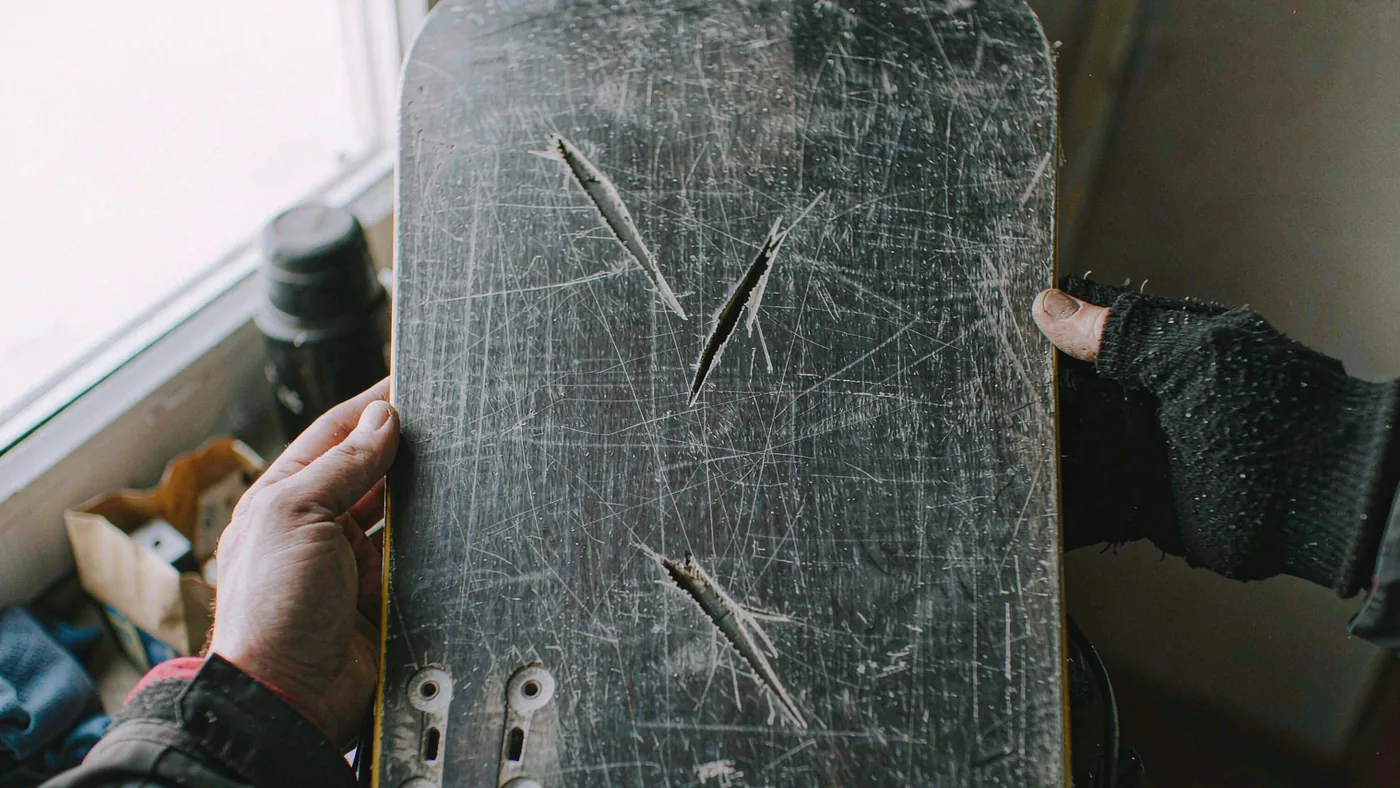
Base, held to the light. Hold the board so light rakes across the base rather than falling straight onto it, and look along its length. Scratches you can see but cannot catch a fingernail on are cosmetic. A gouge you can catch a nail in is usually repairable. A gouge where a different colour shows underneath — sometimes fibrous — has reached the core and needs a proper repair before the board sees snow again.
Edges, with a fingernail. Run a nail along the full length of both edges and feel for burrs, flat spots and sections filed back to almost nothing. A thin edge means a board ridden hard on hardpack and serviced repeatedly; a rounded or missing section means it has been tuned badly or ground down.
Edge separation. Look at the join between the metal edge, the base and the topsheet. Any crack, gap or lifting lets water in. This is a structural fault rather than a cosmetic one, and it is the fault that most often turns a bargain into a workshop bill.
Topsheet, especially under the bindings. Look for delamination — a bubble or a lifting layer — and for compression marks where the bindings were mounted. Deep crushing around the inserts suggests a board ridden hard with the hardware at full torque, and can mean the insert pack is compromised.
Flex, both halves. Hold the board on its tail and press the nose with your palm, then repeat at the other end, then push the middle away from you. You are looking for two things: whether the two ends feel similar, and whether there is an obvious soft area between the bindings where the board has been loaded thousands of times.
Inserts. Shine a torch into each hole. The threads should be clean and square, not stripped, rusted or filled with resin. Damaged inserts are why cheap boards are cheap, and there is no cheap fix.
Profile, sighting down the board. Lay it on a hard floor and sight from the tail, or press the middle down with your foot and watch the contact points. Camber that has gone flat has lost the pop and grip the model was built around. Compare what you see against what the profile should be, which is where the camber profiles guide helps.
| Fault | How to spot it | Cheap to fix? | Walk away if |
|---|---|---|---|
| Light base scratches | Visible in raking light, no nail catch | Yes — a wax and scrape | Never |
| Gouge catching a fingernail | Nail catches, base still visible beneath | Usually — a base repair | They cover the whole running surface |
| Core shot | Different colour or fibre visible in the gouge | Sometimes, professionally | It sits under the binding area or along the edge |
| Rusted edges | Orange-brown patches along the edge | Yes — service and a gummi stone | The rust has pitted deep into the metal |
| Edge separation | Crack or gap between edge and base | No | Almost always |
| Topsheet delamination | Bubble, lifting or peeling layer | No | Almost always |
| Compression at the inserts | Crushed or dimpled topsheet, loose threads | No | Any insert is compromised |
| Flat camber | Board lies flat where it should arch | No | You wanted the grip that profile provides |
| Dead spot | One area presses much more easily | No | It is a large soft area between the feet |
Editorial inspection guidance based on how used boards normally wear, last checked 28 September 2026. Whether a specific fault is repairable depends on the damage itself, so treat this as a filter rather than a verdict.
The two-minute version
If the seller is standing over you, do these five things in order.
Hold it to the light. Raking light shows base damage that photographs hide.
Run a fingernail along both edges. Nail catches mean repair; flat spots mean wear.
Sight down the length. Look for twists, kinks and a nose that has been bent back.
Press both ends. The two halves should feel similar, with no obvious soft patch.
Look at the inserts. Clean threads, no rust, no resin.
Then ask what happened to the board. A rider who can tell you where they rode and why they are selling is easier to trust than one who says it was ridden twice.
Faults that are cheap, and faults that are not
Cheap and normal. Light base scratches, a dry base, dull edges, worn wax and faded graphics. These are maintenance rather than damage, and all of them improve with an afternoon's work or a shop service. They should not stop you buying a sound board.
Cheap if caught early. A small gouge, a rust patch, a burred edge, one unused insert that is not needed for your stance. Repairing base scratches covers the work.
Expensive and structural. Edge separation, topsheet delamination, compression under the bindings, several stripped inserts, and a core shot along the edge or beneath the binding. These end negotiations, and no discount normally makes them worthwhile.
Expensive because it is invisible. A dead spot or a flattened profile will not appear in a photograph and may not show in a ten-second flex test. That is why you press both ends and sight along the board rather than trusting a description, and why buying unseen should be priced accordingly.
Buying used without getting burned
Meet in daylight, with a hard floor. Light and a flat surface do most of the work in this inspection, and neither is available on a dark street.
Bring a screwdriver and test the mounts. Knowing your bindings fit and the screws torque down cleanly is worth the pocket space.
Check the model year. Graphics change annually, and a five-year-old board sold as current-season is a pricing conversation worth having early. Our spec sheet guide explains which numbers to confirm once you know the model.
Never buy used boots or a used helmet. Boot liners mould to the first owner's foot, and a helmet's history cannot be verified. Boards and bindings are the two components that buy well second-hand.
Verdict
If you cannot inspect it in person, or you are buying for a rider who will not notice a dead spot or a flat profile, buy new from a shop and accept the smaller range your money buys. Used boards reward a buyer who knows what they are looking at, and a first-time buyer already has enough decisions without adding an inspection to the list.
Frequently asked questions
Is a scratched base a problem?
Usually not. Scratches visible in raking light that you cannot catch with a fingernail are cosmetic and disappear under a wax. What matters is a gouge that catches the nail, and above all a gouge where a different colour or exposed fibre shows underneath, which means the damage has reached the core.
How can I tell if a used board has lost its camber?
Lay it on a hard flat floor and sight along it from one end. A cambered board should sit on its contact points with a visible arch under the middle. If it lies flat, or the middle touches the floor, the profile has gone and the board will feel less poppy and less grippy than the model should.
What is a dead spot on a snowboard?
A section that flexes much more easily than the rest, usually between the bindings where the board has been loaded many times. You find it by pressing both ends and by pushing the middle away from you. A board with a dead spot turns unevenly and feels vague at speed.
Which faults are worth repairing?
Small base gouges, rust, burred edges and a dry base are cheap fixes that leave a sound board. Edge separation, topsheet delamination, compression under the bindings and stripped inserts are not, because they are structural, and correcting them properly costs more than the board is worth.
Where to go next
Where to go next
If you are still deciding, new versus used weighs what you get either way, and where to buy snowboards in the UK covers the retail and classified routes. Once you own the board, board care and storage explains how to keep it in condition, and sintered versus extruded bases explains why the same damage matters more on one than the other.