You hear it rather than feel it: a dry, grinding scrape under the board as you cross a thin patch of cover on the way back to the lift. At the bottom you turn the board over and there it is, a white line running a few centimetres across the base. The immediate question is whether the holiday is over, or whether that is simply what a snowboard base looks like after a week.
The answer is almost always the second one. Bases are designed to be scratched. The material is soft precisely so that it can absorb damage that would otherwise reach the wood and fibreglass underneath. Most marks scuff the surface and nothing else, and after a wax they are invisible from a metre away.
One kind of damage is different. If a gouge has gone through the base material and the black layer underneath, the board has an open wound exposing its core, and that stops being cosmetic and becomes urgent.
What actually matters
Sintered or extruded changes how much damage you get and how easy it is to repair. An extruded base is pushed through a die as molten material: cheap, tough, and poor at holding wax. A sintered base is compressed from powder under heat: it absorbs wax properly, glides better, and is softer and more prone to gouges. A sintered base collects more scratches from the same rock and also takes a proper repair better. Our sintered vs extruded guide covers the trade-off.
A scratch that does not reach the black is cosmetic. The base of most boards is a coloured layer over a black layer. If only the colour is disturbed, the damage is shallow enough that a wax and a scrape will largely disguise it. If you can see black, you are into the structural material. If you can see something fibrous or wooden, you have reached the core.
A core shot is urgent, and the urgency is about water. The core is wood or a foam composite, and it will rot or delaminate if it stays wet. Snow melting on the base runs into an open gouge and stays there. That is why a core shot must be sealed before the board goes back on snow — not because the board will break, but because the interior starts coming apart from the inside over the following weeks.
Do not put a wet board away. A board that goes into a bag damp with an open scratch is exactly the condition that produces rot. Dry the base and the edges, and if there is any doubt whether a gouge reaches the core, treat it as though it does.
Sorting harmless from urgent
Almost everything you find on a base falls into one of four categories, and only the last two need action.
| Damage | What it looks like | Urgency | Who should fix it | If you leave it |
|---|---|---|---|---|
| Surface scuff | Faint marks in the colour layer, no black visible | Cosmetic | Nobody, or you with a wax | Nothing — it disappears under wax |
| Deep scratch | Black visible, but the surface is closed and flat | Low | You, at home, with a P-Tex candle | Slight drag, and wax will not sit in the channel |
| Core shot | Grey, fibrous or wooden material visible | Urgent, before the next day on snow | You if small, a shop if wide or deep | Water in the core, which can rot or delaminate the board |
| Delamination or a lifted edge | Base peeling from the edge, or the edge standing proud | Urgent, and not a home repair | A workshop | Structural failure, and possibly an unrepairable board |
Published specifications, last checked 28 September 2026. The urgency and the repair route for each category are editorial judgement based on how base materials behave rather than measured testing.
P-Tex and base weld are not the same thing
The two terms get used interchangeably in shops and they are genuinely different materials for different jobs.
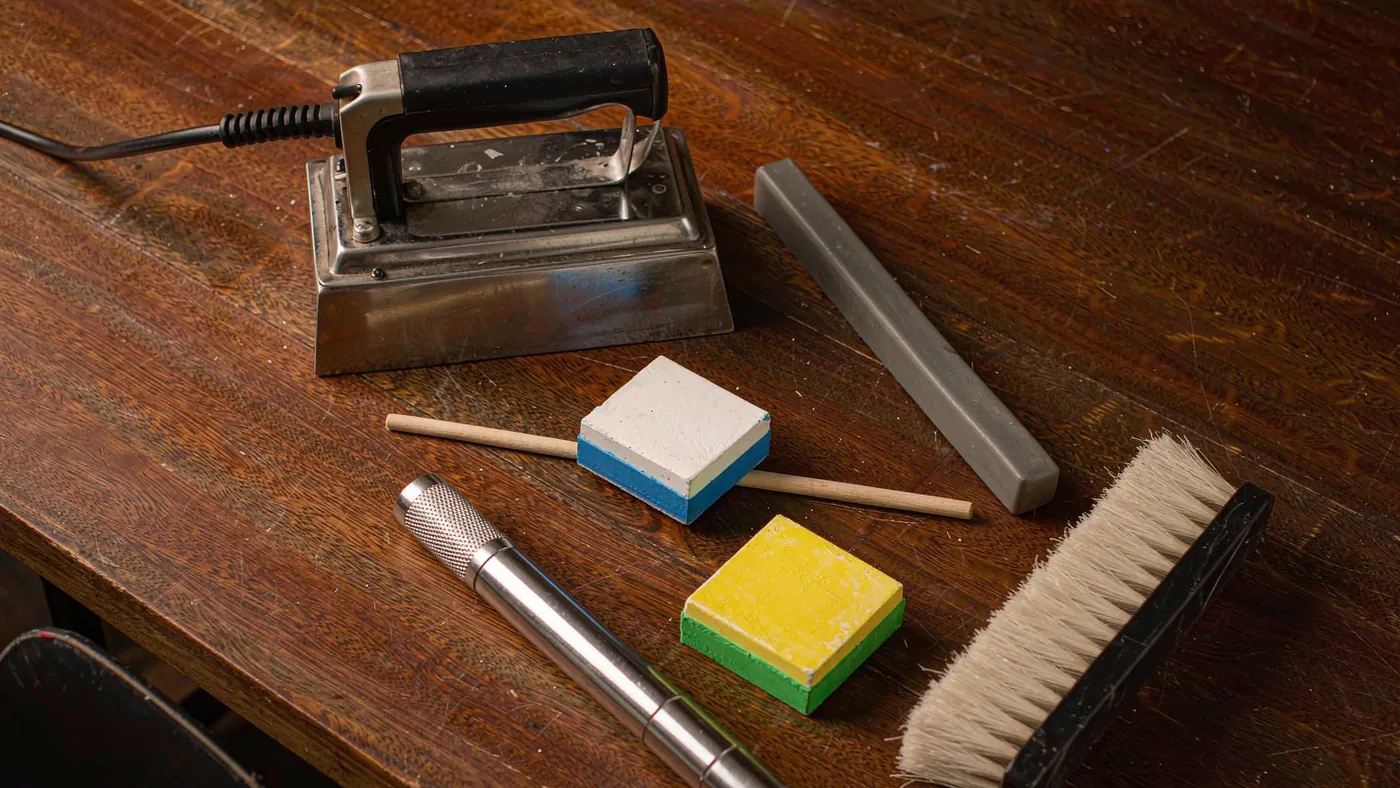
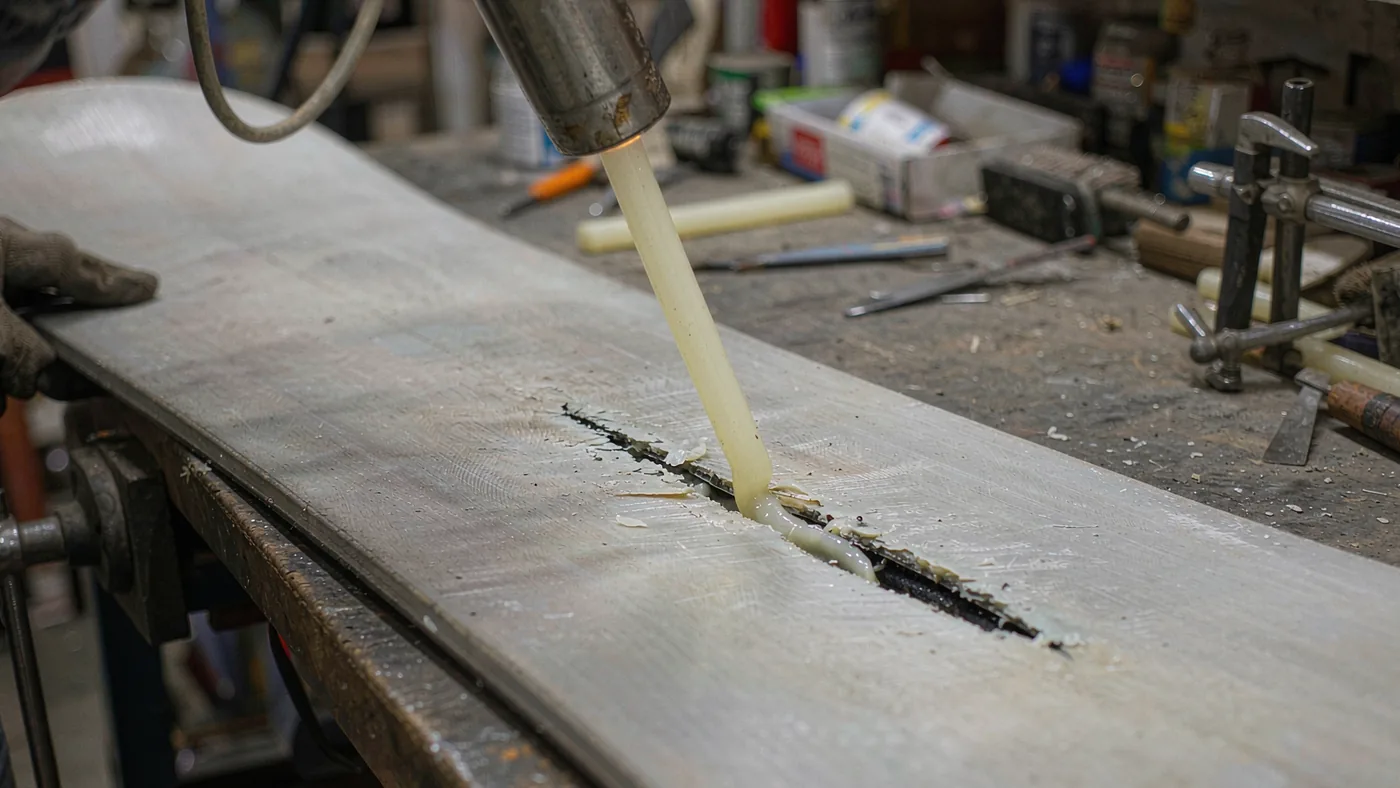
P-Tex candle is the classic repair: a stick of polyethylene that you light and drip into a cleaned gouge, then scrape flat once it has cooled. It works well for narrow scratches and shallow gouges. Because it is softer than the surrounding base it wears faster, and a P-Tex-filled scratch will reappear as a faint line after a few weeks. That is normal rather than a failure.
Base weld is a thicker, harder repair material, usually applied with a dedicated gun or as a shaped patch, and it bonds to the base more aggressively than a candle. It is the right choice for wider gouges, for damage near the edge, and for anything you need to last.
The repair, step by step
For a narrow scratch or a small core shot, this is genuinely doable at home with a plastic scraper, a sharp tool and a candle.
- Dry the board completely and bring it to room temperature. Snow melting in the gouge while you work is the main reason home repairs fail.
- Clean the gouge out with a sharp pick or a craft knife, lifting out dirt, grit and loose base material. A repair bonded to dirt pops out within a run or two.
- Wipe with isopropyl alcohol and let it evaporate fully. P-Tex will not bond to a damp or greasy surface.
- Drip the P-Tex in, holding the candle above the gouge and letting it fall in, filling slightly proud of the surrounding base.
- Let it cool completely — ten to fifteen minutes, not two. Scraping warm P-Tex pulls it back out of the hole.
- Scrape flat with a plastic scraper at a shallow angle, working along the length of the board until the fill is level with the base.
- Wax the board. The repaired area is dry and porous, and waxing straight afterwards stops the repair sitting proud again after a few runs.
When the shop is the only sensible option
Anything wider than a pencil. A wide gouge filled with a P-Tex candle will look repaired and then fall out, because the fill has too little surface to bond to.
Anything that touches the edge. This is where the base, the steel and the sidewall meet, and a home repair beside a rolled edge usually leaves a gap that lets water in.
Any case where you are not certain the core is dry. If the board has been ridden for days with an open gouge, the core may already be damp. Sealing a wet core at home traps the moisture inside.
If you cannot see the bottom of the gouge, if it is wider than a pencil, or if it sits anywhere near the edge, do not fill it yourself. The cost of a shop repair is a fraction of the cost of a delaminated board, and a bad home repair hides the damage until it is too late to fix. Take it in, ask them to dry it out properly, and treat the P-Tex candle as what it is — a good tool for narrow, clean, shallow damage and nothing more.
Frequently asked questions
How do I know if a scratch needs repairing?
Look at the colour. If only the coloured layer is marked, leave it and wax the board. If you can see black, fill it with a P-Tex candle when convenient. If you can see grey, fibrous or wooden material, it is a core shot and must be sealed before the board goes back on snow.
Can I ride with a core shot?
Not safely, and not without cost. The board will feel fine, which is the problem — the damage is happening inside, where melting snow works into the core and starts the process of rot. Seal it before the next day, even if the fix is temporary.
How long does a P-Tex repair last?
A properly cleaned and filled narrow scratch will usually hold for a season or more, though the fill is softer than the surrounding base and will gradually wear into a faint line. A wide or badly cleaned repair can come out within a few runs.
Is a core shot the same as a deep scratch?
No. A deep scratch stays within the base material and is a low-priority repair. A core shot has broken through into the structural layers underneath, and the risk is water rather than strength. The two need different urgency.
Should I repair my own base or pay a shop?
Narrow, clean, shallow damage and small core shots well away from the edge are reasonable home repairs. Wide gouges, anything touching the edge, anything you cannot see the bottom of, and any base lift belong in a workshop.
Does a repaired base ride differently?
Rarely in any way you would notice. A good repair sits flush with the surrounding base and the board glides normally over it. You are more likely to notice the dry, unwaxed area around a fresh repair, which is why waxing afterwards is part of the job.
Where to go next
For the base material question in more depth, read sintered vs extruded bases, and for the seasonal routine see snowboard care, waxing and storage. Our guide to waxing and tuning at home covers keeping a repaired base running well, and how to inspect a used snowboard walks through the checks if you are buying secondhand. There is more in the advice section.