The coldest feet on any mountain belong to the rider who bought the thickest socks. It is a strange result to anyone who has not thought about it, because insulation is normally about thickness: the puffer jacket is warmer than the shell, the 250-weight merino is warmer than the 150. Socks are the exception, and the exception catches out almost every beginner.
Here is what happens. You pull on a thick sock, push your foot into a boot that fitted perfectly in the shop, and the boot is now tight. Tight is the enemy of warm. A sock only insulates while there is still air trapped in it and blood still flowing through the skin it wraps, and a thick sock in a snug boot takes away both. Your foot ends up compressed, cold and damp, and you spend the day blaming the boots.
This article is not a round-up of specific socks. It is the reasoning you need before you buy any pair, because the answer depends far more on your boots than on the sock.
What actually happens inside a boot
Circulation beats insulation. Heat arrives at your toes in your blood, and blood flow through the foot is easily restricted by pressure. Anything that squeezes the foot — a thick sock, a boot that is a half-size too small, a binding strap over the instep — reduces that flow. A foot with poor circulation will be cold no matter how much wool surrounds it.
A liner packs out around whatever you wear. Boot liners are heat-mouldable and they take a set. If you break a boot in with one pair of thick socks and then ride in thin ones, the boot will feel loose and sloppy. If you break it in with thin socks and then wear thick ones, it will feel tight. The sock and the boot are one decision, not two.
Moisture is what makes cold unbearable. Feet sweat, even in the cold, and a damp foot loses heat far faster than a dry one. The sock's real job is to move that moisture away from the skin into the boot's lining, and a fabric that holds water — cotton above all — stops the process dead.
Height matters as much as thickness. A sock that stops below the top of the liner leaves a hard rim pressing on the shin every time you flex forward. A sock that climbs well above the boot cuff sits comfortably against the liner instead.
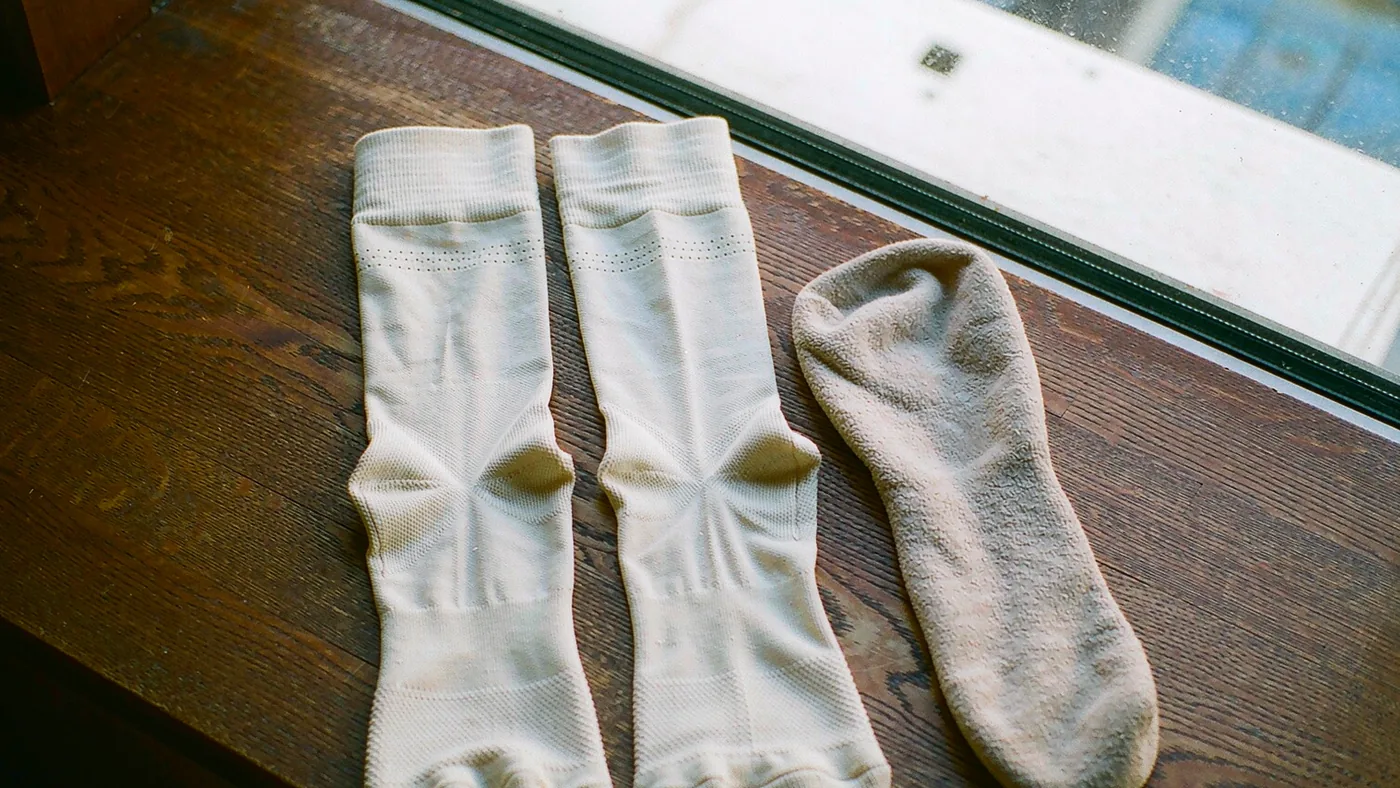
Seams and shape decide the pressure points. A bulky toe seam presses on the toes. A heel pocket that does not match your heel bunches under the arch. Socks sold in left and right shapes exist for this reason, and they are worth the small extra.
Merino, synthetic or blend
| Fabric | How it feels | Drying | Smell after a week | Durability | Who it suits |
|---|---|---|---|---|---|
| Fine merino wool | Soft, warm when damp | Slower | Excellent | Wears through at heel and toe first | Multi-day trips and riders who get cold sitting still |
| Merino blend | Similar, slightly drier feel | Moderate | Very good | Better than pure merino | Most riders, most conditions |
| Synthetic polyester or polypropylene | Cooler, slicker, moves moisture fastest | Fast | Noticeable after two days | Very good | Multi-day riders who wash kit in a basin |
| Bamboo or viscose blend | Soft, midweight | Moderate | Moderate | Moderate | Casual riders in mild conditions |
| Cotton | Feels fine when dry | Never really dries | Poor | Good | Nobody, on a mountain |
Fabric behaviour describes well-established textile properties rather than measurements of any particular sock, last checked 28 September 2026. The order of the table is our editorial ranking for a one-week-a-year rider.
What you actually want to look at
A snug fit with no wrinkles. Pull the sock on and run your hand over it. Any fold will become a pressure point within an hour. The toe should have a little room to move; the heel should sit in the heel pocket rather than somewhere near your arch.
Cushioning where you need it, not everywhere. Heel, toe and shin cushioning absorbs pressure from the boot and the binding. Cushioning through the arch and the instep makes the boot feel tighter, which is exactly what you do not want.
A material that still insulates when damp. Wool keeps a useful amount of warmth when wet, which is why it is the default for cold days. Synthetics dry far faster, which matters more on a multi-day trip with limited drying space.
How socks and boots interact
The place to get this right is the shop, and the rule is simple: try boots on with the socks you intend to ride in, not with the socks you happened to be wearing. A boot that fits over a thin sock will be tight over a thick one, and the difference between those two is roughly enough to change the boot's size.
Sizing is usually given in Mondopoint, the centimetre measurement of your foot, rather than the shoe size you wear. Measure the foot, allow a little room at the toe, and keep the sock consistent from the fitting onwards. A liner that has moulded itself around a thick sock will feel loose and vague in a thin one.
If your boots are already correct and your toes are still cold, the answer is almost never more insulation around the foot. Warm the rest of yourself, keep your base layer dry, and check the boot is not done up so tightly that the instep is nipping the top of the foot. Riders who lace up hard at the bottom of the mountain, before the walk from the car park has even warmed them up, are the usual victims.
The question of thickness, answered
For a snug, well-fitted boot, wear a thin or midweight sock. For a boot that is genuinely a little roomy, wear a midweight sock plus a slightly thicker cushioning sock — one sock, more material, not two socks. For extremely cold days on a chairlift, the answer is a midweight merino sock with cushioning at the toe, plus warmer boots or a boot glove, plus a midlayer you can add at the top of the lift.
If you ride in the Alps in February and you are used to cold feet, buy one thin pair and one midweight pair and decide over the week which one the boot likes. It costs very little compared with the rest of the kit and it is the only way to know.
Verdict
If your boots are genuinely a half-size too large, thin socks alone will leave your foot sliding and your toes knocking, and the honest answer there is that you should fix the boot fit before you buy any sock. Riders who stand still for long periods on a cold chairlift will also want a midweight merino sock with real cushioning rather than the thinnest liner sold. Where thin socks are wrong, the socks are not the problem.
Frequently asked questions
Do thick socks keep your feet warmer snowboarding?
No, and they usually make things worse. A thick sock tightens the boot, restricts the blood flow that carries heat to your toes, and presses the loft out of the fabric that was meant to insulate. Wear the thinnest sock that fits snugly without wrinkles in a boot that fits properly.
Should I wear two pairs of socks in snowboard boots?
One pair, always. Two pairs squeeze the foot, create folds that press on the skin, and slow down the movement of moisture away from the foot. If you feel you need two pairs, the boots are too big by a size or more, and the cheaper fix is a thicker single sock.
How high should snowboard socks be?
High enough to clear the top of the boot liner by a few centimetres, so the boot cuff presses on fabric rather than bare shin. A sock that stops at the liner's top edge will leave a hard rim against your leg every time you flex your ankles forward.
Are merino socks worth the extra money?
They are worth it if you ride several days in a row or you get cold sitting on lifts. Merino keeps some warmth when damp and does not develop the smell that synthetics do by day three. If you ride one week a year and wash kit each night, a synthetic sock dries faster and costs considerably less.
Can I wear ordinary sport socks snowboarding?
A cotton-rich everyday sock is the worst choice, because it holds water against your skin. A thin synthetic running sock is a better fallback than a thick cotton one, and it will keep you comfortable for a short session on an indoor slope.
Where to go next
Sock choice is really boot fit in disguise, so read the boot size versus shoe size guide and the how to break in snowboard boots walkthrough before you spend anything. The best snowboard boots for beginners round-up covers what to look for in the boot itself.
The layer above your feet matters too, and the best base layers for snowboarding explains the rest of the system around your skin. More of the same sits in outerwear, or browse the advice section.