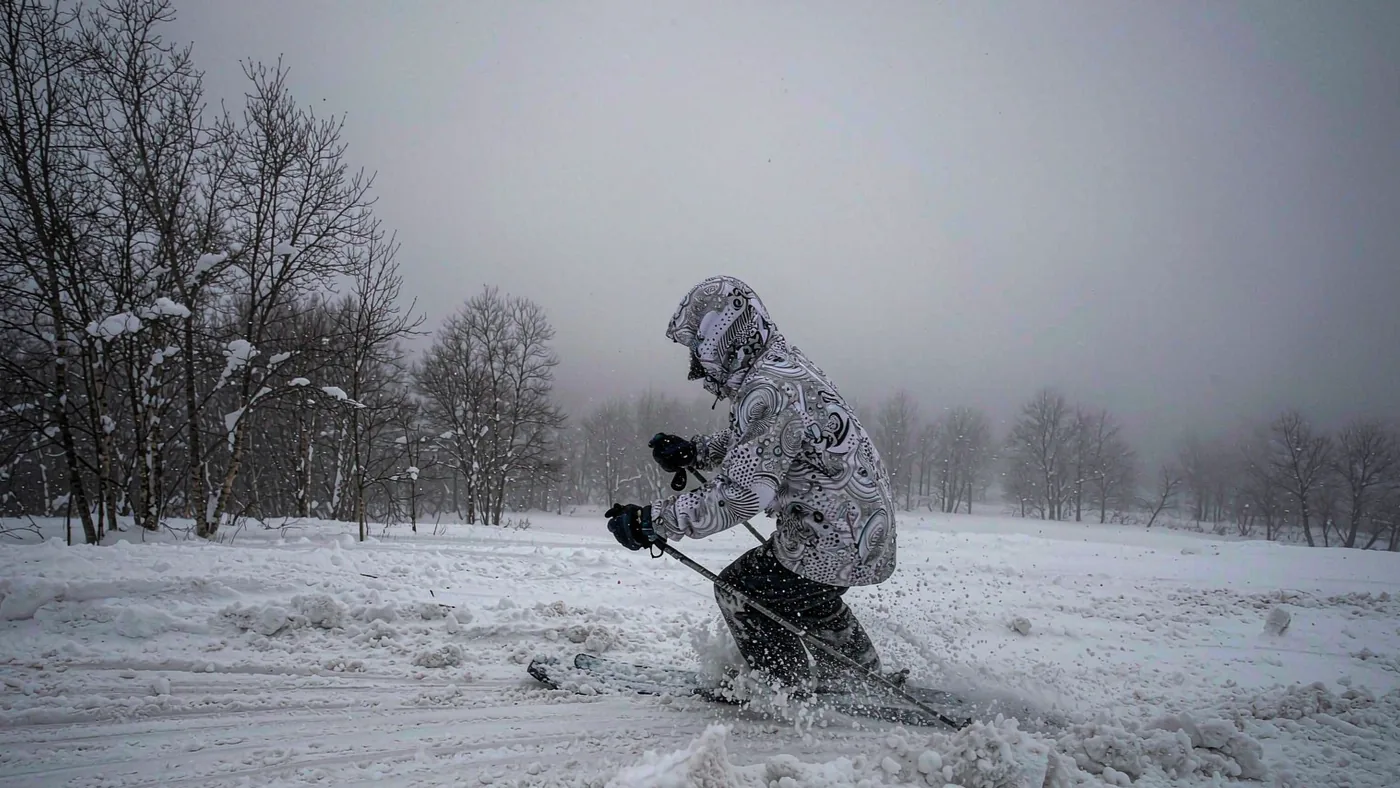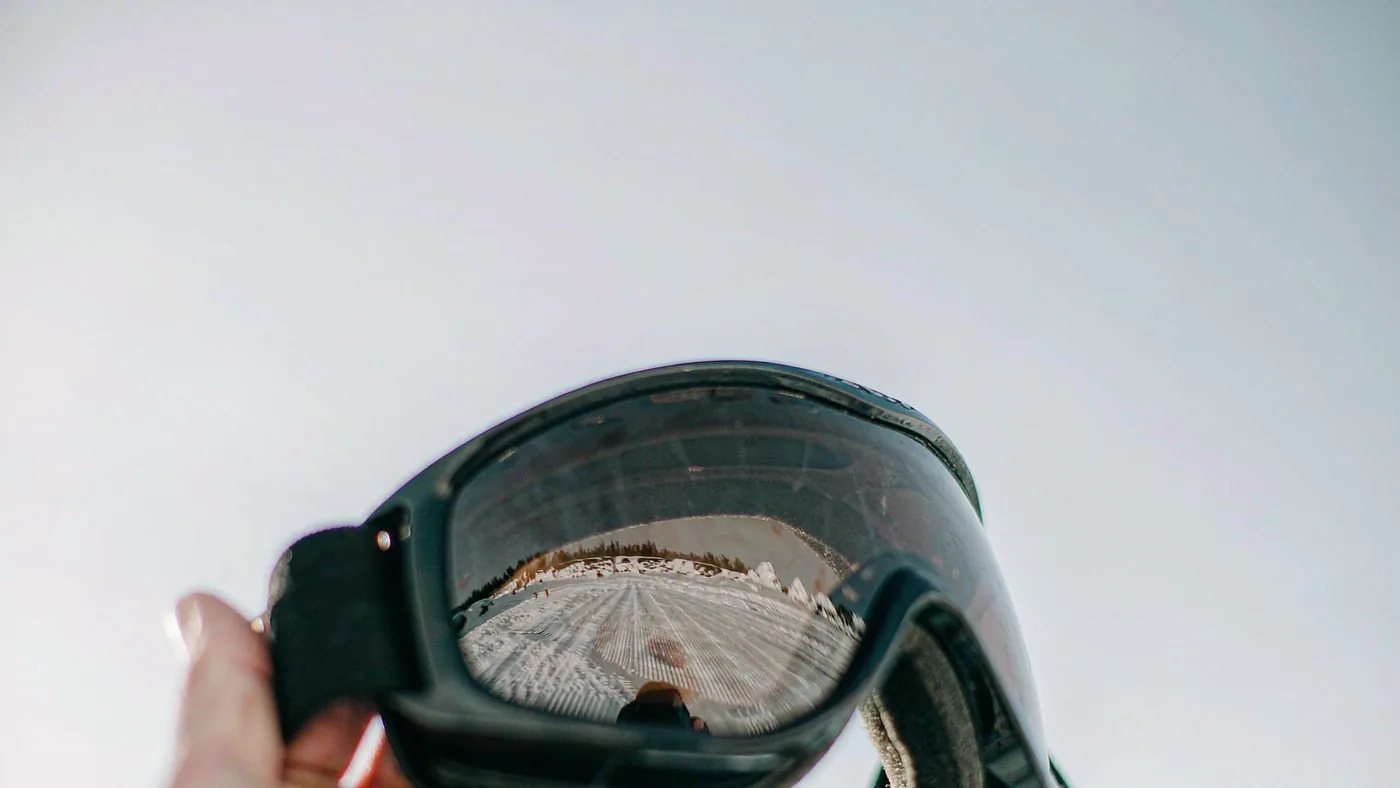
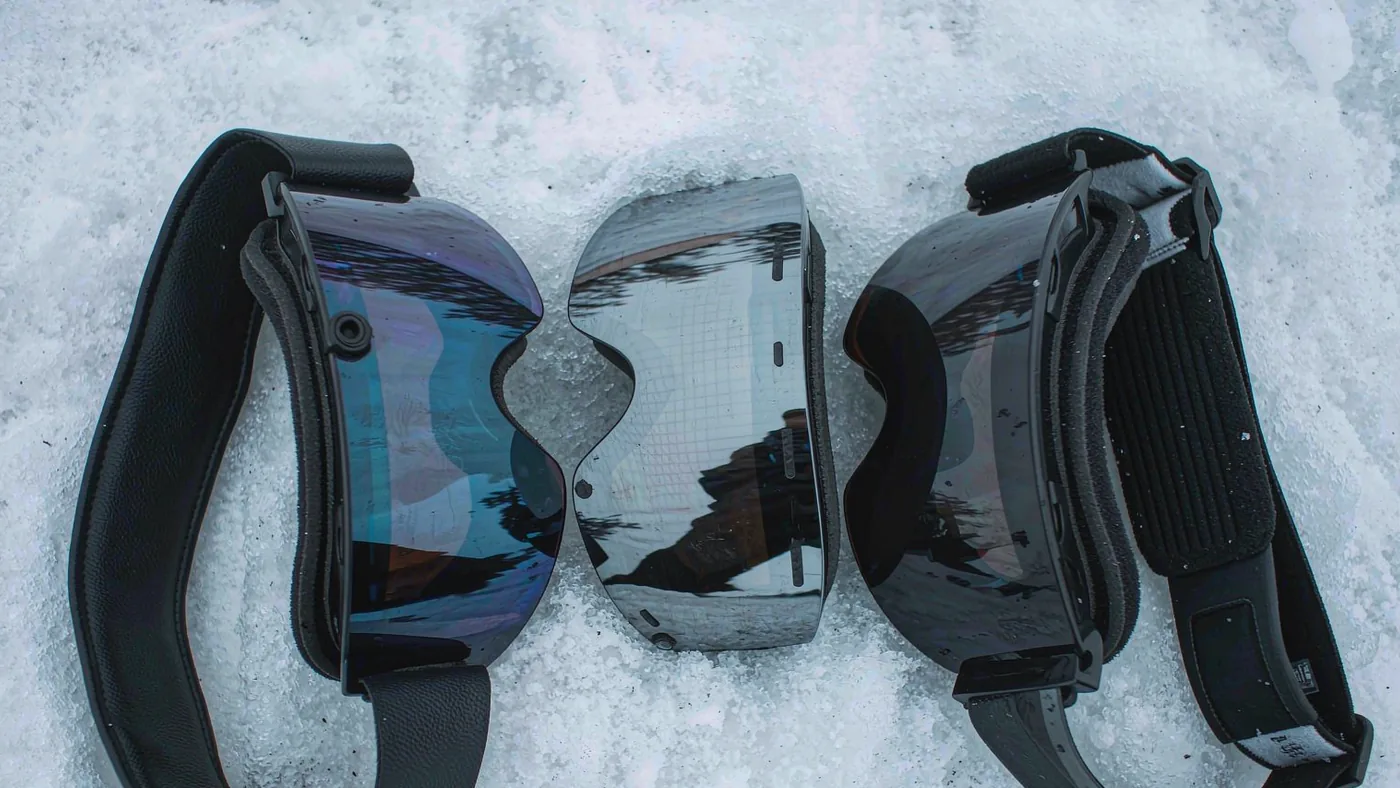
The afternoon the light goes flat, you have two possible problems and only one of them is your technique. The first is that the snow has lost its shadows and your eyes cannot tell a soft patch from a groomed one. The second is that you are wearing a dark mirrored lens and have made the first problem worse. Riders spend a fortune on glass for a bluebird day on a glacier, then ride eleven grey mornings a season with the wrong lens, wondering why they feel so tentative.
Lens choice is not a fashion decision and it is not about the mirror finish, which is mostly cosmetic. It comes down to how much light the lens passes and what it does to the colours in that light. Both of those are properties you can read on the label, once you know which number to look at.
VLT — the number that actually matters
Visible light transmission, or VLT, is a percentage. A lens with a very high VLT lets most of the light through and looks almost clear. A lens with a low VLT looks nearly black. Every serious goggle lens is published with a VLT figure, and it is the first thing to compare.
The conventional bands. Lenses are usually grouped from category zero to category four. Category zero is essentially clear and is intended for night or very dark conditions. Category one is a high-transmission lens for heavy overcast, category two an all-round lens for mixed light, and category three for bright sun. Category four is for glacier light and high altitude, and is generally not recommended for driving.
Why a dark lens fails on a grey day. A low-VLT lens reduces brightness without restoring contrast. On flat light the problem is not that things are too bright, it is that the snow, the sky and the terrain all sit at nearly the same tone. Making everything darker and equally grey removes the last information your eye was using.
Why a clear lens is not the answer either. A clear lens passes plenty of light but does nothing to separate tones, so you get a bright, featureless view. The useful answer sits in the middle: enough transmission to keep the surface bright, and a tint that maximises the difference between the tones you need to read.
Colour, and what it does to a grey day
Rose, copper and amber. These are the classic contrast tints for low light, and they are what most brands mean by a storm or low-light lens. They filter the blue end of the spectrum and strengthen the difference between shaded snow and lit snow, which is exactly the cue you need when the horizon has vanished. Grey and smoke tints do the opposite: they reduce brightness neutrally without pushing the colour balance, which is comfortable in strong light and unhelpful the moment it goes flat.
Mirror coatings. A mirrored finish reflects light away before it reaches your eye, which lowers the effective VLT and reduces glare. On a bright spring day at altitude that is what you want; on a grey afternoon the same coating is subtracting light you needed. The colour of the mirror is largely cosmetic, and the useful information is the underlying tint and the VLT figure.
| Lens type | Light it suits | How it affects contrast | Weakness | One-lens case |
|---|---|---|---|---|
| High-VLT rose or copper, no mirror | Heavy overcast, snow, flat light | Strong — separates shadow from lit snow | Overwhelming in bright sun | The best single lens for a European winter |
| Low-VLT mirrored lens | Bright spring sun, glaciers | Reduces brightness, not much contrast | Poor in cloud and late afternoon | A spare lens, not an everyday one |
| Photochromic lens | Light that changes through the day | Moderate, varies with the light | Typically the most expensive option | Convenient if you will not swap lenses |
| Polarised lens | Bright glare off snow and ice | Cuts reflected glare | Can flatten the cues that reveal icy patches | Useful in spring, debated in the cold |
Category bands, tint behaviour and VLT ranges are long-established industry conventions; individual lenses vary. Published specifications, last checked 28 September 2026. The one-lens judgement is editorial.
The picks
A large, toric-lens goggle with excellent peripheral vision and a magnetic lens swap. One of the best options for flat light and fog.
Best for
- Flat-light riding
- Glasses wearers
Worth skipping if
- Small faces
- Tight budgets
- Lens
- Toric, magnetic interchange
- Fit
- Large, OTG compatible
- Intended use
- All-mountain
Strengths
- Outstanding field of view
- Excellent in flat light
- Fast lens changes
Trade-offs
- Very expensive
- Can overwhelm a small face
Specifications reflect published manufacturer information, last checked 2026-09-28. We have not laboratory-tested this product; the assessment above is editorial, based on the published design and the rider profile it targets. How we review gear.
The magnetic swap is genuinely fast, which matters more than it sounds when the light changes mid-run. Expensive, and worth it if you ride flat light often.
Best for
- Riders who change lenses often
- Flat-light conditions in the Alps and Scotland
Worth skipping if
- Riders who leave one lens in all season
- Budget builds
- Lens
- Magnetic interchangeable spherical
- Fit
- Medium, OTG compatible
- Intended use
- All-mountain
Strengths
- Fastest lens swap of the options here
- Clear optics across the whole field
- Two lenses covers most conditions
Trade-offs
- Premium price
- Magnetic system needs care when packed in a bag
Specifications reflect published manufacturer information, last checked 2026-09-28. We have not laboratory-tested this product; the assessment above is editorial, based on the published design and the rider profile it targets. How we review gear.
A dependable goggle with a broad field of view. Swap lenses for the flat-light days and it will handle almost any European weather.
Best for
- Riders dealing with changeable Alpine light
- Glasses wearers wanting an OTG-friendly fit
Worth skipping if
- Riders wanting a single lens that does everything
- Tiny faces
- Lens
- Interchangeable cylindrical
- Fit
- Medium, OTG compatible
- Intended use
- All-mountain
Strengths
- Large field of view without looking oversized
- Lens changes are quick with cold hands
- Works well over glasses
Trade-offs
- Cylindrical lens shows slightly more distortion at the edges
- Spare lenses add cost
Specifications reflect published manufacturer information, last checked 2026-09-28. We have not laboratory-tested this product; the assessment above is editorial, based on the published design and the rider profile it targets. How we review gear.
How they compare
| Goggle | Lens geometry | Lens change | Internal depth | Best suited to | Main trade-off |
|---|---|---|---|---|---|
| Anon M4 | Toric, magnetic interchange | Magnetic | Large, OTG compatible | Flat light, glasses wearers, wide views | Very expensive, and it can overwhelm a small face |
| Smith I/O MAG | Spherical, magnetic interchange | Magnetic, the fastest here | Medium, OTG compatible | Riders changing lenses through the day | Premium price, and magnets need care when packed |
| Oakley Line Miner M | Cylindrical, interchangeable | Manual | Medium, OTG compatible | Changeable Alpine light and glasses wearers | Slight edge distortion, and spare lenses cost extra |
Lens geometry and fit follow published manufacturer information, last checked 28 September 2026. Field of view and suitability for each light condition are editorial judgements from the frame design.
If you own only one lens
For a European winter, the single lens to own is a high-transmission contrast tint in rose, copper or amber, with no heavy mirror. It is not the lens that looks best, and it is not the lens that wins on the bluebird day of your trip. It is the lens that is right on the grey, low-horizon days that make up a large share of an Alpine season and almost all of a Scottish one.
If your goggle takes a swap, the second lens should be a low-VLT mirrored lens for bright spring snow and high-altitude days. The one combination that does not work is a single dark mirrored lens — the lens most riders buy, because the mirror looks convincing on a shop wall, and the one that fails you precisely on the day you most need help.
How flat light actually affects the Alps and Scotland
In the Alps, flat light tends to arrive in the afternoon, when cloud comes over the ridge and the contrast in the snow collapses. Riders who are tired and cannot see the terrain start making small errors, which is how afternoons go wrong.
In Scotland, flat light is not an event, it is the standard condition for weeks at a time. Add wet snow and horizontal sleet, and the tint is one of the few pieces of equipment that changes anything at all about your day.
Verdict
If you ride Europe in winter and you can only afford one lens, do not spend it on a mirrored one, however good it looks. Buy the contrast tint and add the mirror to a spare. Riders who only ever ride bright spring snow at altitude, and riders who genuinely will not change a lens mid-season, can ignore that advice — for them the mirror is the right lens, and the flat-light one would sit in a bag.
Frequently asked questions
What VLT should snowboard goggles be?
For flat light, look for a high-transmission lens in the category one band, in rose, copper or amber. For mixed light, a category two lens is a reasonable all-rounder. Save the darkest, most mirrored lenses for bright spring sun at altitude, where they cut glare rather than information.
Do tinted goggle lenses really help?
Yes, and the effect is largest in low light. A contrast tint such as rose or copper strengthens the difference between shaded and lit snow, which is the cue that flat light removes. A dark neutral or mirrored lens reduces brightness without adding contrast, so it makes the same problem worse.
Are mirrored lenses better than non-mirrored?
Not better, different. The mirror coating reflects light away and lowers the effective transmission, which is useful in bright sun and unhelpful in cloud. Buy the mirror for the sunny days and the contrast tint for the grey ones, and if you own only one lens, own the contrast tint.
Are photochromic goggle lenses worth it?
They are convenient if the light changes from grey to bright during your day and you will not swap lenses, which is exactly what happens in spring. The trade-offs are a higher price than fixed lenses and a slower response in cold conditions. If you own a magnetic goggle, two fixed lenses are usually better value.
Why do I see less with dark lenses on cloudy days?
Because the problem in flat light is a lack of contrast rather than too much brightness. A dark lens dims everything equally, so the small tone differences between snow, shadow and sky shrink further. A contrast tint instead stretches those differences apart, which is what your eyes need.
Where to go next
If your problem is moisture rather than light, how to stop goggles fogging deals with the ranked fixes, and the best snowboard goggles under 200 guide covers what a mid-range budget buys. The goggles for flat light round-up applies all of this to the worst conditions in the Alps and Scotland.
Goggles and helmets work as one system, so read the best snowboard helmets round-up and the helmet buying guide behind it. More of the same sits in outerwear.