
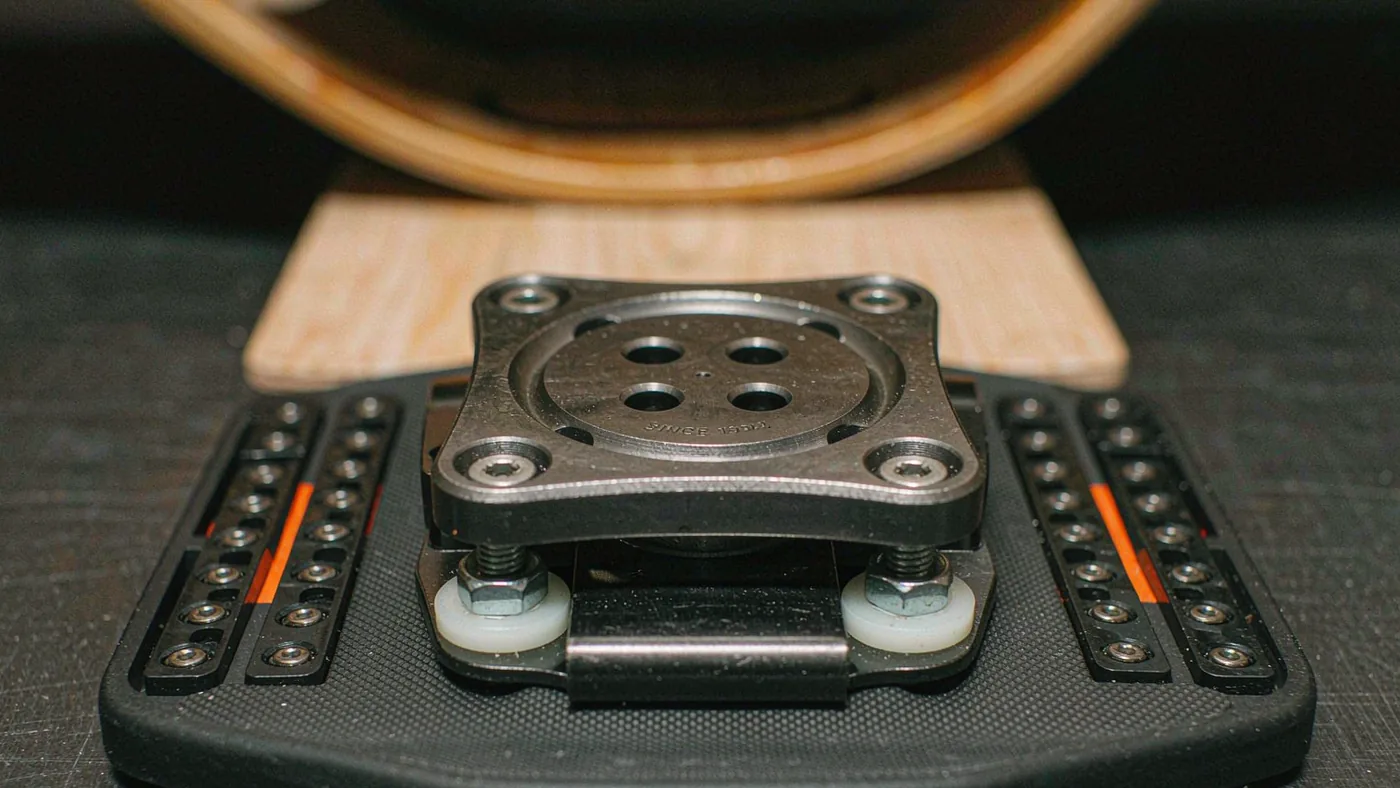
The bindings arrived on a Thursday and the board turned up the following Tuesday, and the two of them did not fit together. Nothing was faulty. The discs in the box were built for a standard two-by-four insert pack, the board had a channel running down its middle, and the rider had bought in the order most people buy in: bindings in the sale first, board afterwards, on the assumption that everything fits everything.
It usually does — which is what makes the exceptions so annoying. Snowboard hardware has settled into a handful of systems, and if you buy inside the mainstream you will almost never hit a wall. Buy across systems without checking, or buy for a board you plan to own next season, and you can end up with a perfectly good set of bindings that belongs to somebody else.
The order that saves money is compatibility first, size second, flex third. Everything below follows that order.
The three questions that decide whether bindings fit
Mounting pattern. Almost every board on the market uses an insert pack, with the two common variants being a four-by-four grid and a two-by-four pattern; both accept the universal discs that ship with most bindings. Burton boards use a channel instead, and need either that brand's own interface or a binding whose disc is channel-compatible. Manufacturers usually include a channel disc in the box, but "usually" is doing work in that sentence — check the contents list before you order, and check it again if you are buying second-hand.
Baseplate footprint against boot length. A baseplate is a fixed size, and its job is to hold your boot between the heelcup and the toe ramp. What matters is not the waist width by itself but the boot's total sole length at each end. A long boot on a small binding means the toe or heel sits over the edge of the baseplate, which feels vague; a short boot in a large binding means the straps have to travel further to grip, and the foot can shift.
Enough adjustment for your stance. Boards publish a reference stance and a range of positions either side of it. If your natural stance is unusually narrow — a smaller rider, or anyone with a short inseam — check that the innermost inserts give you that width. Tall riders needing a wide stance should check the other end. This is also where a second set of insert positions, or a channel system, gives more freedom than a fixed pack.
Binding size is boot length, not boot size
This is where most sizing mistakes happen, and it has nothing to do with the board. Bindings are built around the front-to-back distance between heelcup and toe ramp, and boot size labels lie about that distance: two UK 9 boots from different brands can be nearly a centimetre apart in sole length. Where a manufacturer publishes a millimetre range, use it. If your boot sits at the very top of a size band, take the larger binding — a loose fit is a small annoyance, a tight one cracks boot shells and jams ratchets over a season.
Women's and junior bindings are built on their own scales rather than being scaled-down versions of the adult range, so a smaller rider should read that chart specifically. The full method, including the adjustments that rescue a marginal fit, is in binding sizes explained.
The picks
Two mid-flex bindings that cover the bulk of recreational riding, and two different answers to the question of what "all-mountain" means.
The default answer when someone asks which all-mountain binding to buy. Strong, simple, and it stays stiff enough to drive a proper board.
Best for
- All-mountain riders doing piste, park and travel
- Riders who want a binding to last several seasons
Worth skipping if
- Riders wanting an ultralight touring setup
- Anyone after a flexy, surfy feel
- Flex bias
- Medium
- Intended terrain
- All-mountain
- Mounting
- Universal disc, most board inserts
Strengths
- Reliable, long-lived and easy to service
- Firm enough for aggressive piste riding
- Straps work well with bulky boots
Trade-offs
- Heavier than premium carbon options
- Not the most playful binding in the park
Specifications reflect published manufacturer information, last checked 2026-09-28. We have not laboratory-tested this product; the assessment above is editorial, based on the published design and the rider profile it targets. How we review gear.
A comfortable, mid-flex binding that suits riders splitting time between park and groomers.
Best for
- All-mountain freestyle riders
- Riders wanting a softer binding
Worth skipping if
- Riders wanting maximum stiffness
- Flex bias
- Medium
- Intended terrain
- All-mountain freestyle
- Mounting
- Universal disc
Strengths
- Comfortable over long days
- Good value in the mid range
Trade-offs
- Less direct than a stiff binding
- Not built for extreme freeride
Specifications reflect published manufacturer information, last checked 2026-09-28. We have not laboratory-tested this product; the assessment above is editorial, based on the published design and the rider profile it targets. How we review gear.
How they compare
| Binding | Flex | Mounting | Best for | Main compromise | Who should look elsewhere |
|---|---|---|---|---|---|
| Union Force | Medium | Universal disc, most board inserts | All-mountain riders doing piste, park and travel | Heavier than premium carbon options and not the most playful in the park | Riders wanting an ultralight touring setup or a surfy, flexy feel |
| Rome D.O.D. | Medium | Universal disc | All-mountain freestyle riders who want a softer, comfortable binding | Less direct than a stiff binding, and not built for extreme freeride | Riders chasing maximum stiffness |
Published specifications, last checked 28 September 2026. Flex and suitability are editorial judgements about how each binding is designed to behave, not laboratory measurements.
Matching flex to the board and the boot
Start from the boot, not the board. A firm binding on a soft, flexible boot does not make the setup stiffer; it crushes the boot and gives you an uncomfortable worst of both. Boot flex and binding flex should sit within about one step of each other. If you are deciding where to spend, spend on the boot.
Then match the board. A medium flex binding is the safe pairing for a medium all-mountain board, which is what most recreational riders own. Put a very stiff binding on a soft park deck and the board stops feeling playful; put a soft binding on a stiff freeride deck and you cannot drive the edge, because the binding absorbs the input before it reaches the board.
Consider how you will carry it. Bindings that are stiff and heavy feel planted on a firm piste and tiring on a long walk or in the park. Weight is the least-discussed specification and the one you notice at the end of the day, on the lift and while carrying luggage.
Check the strap and highback against your boot. A bulky boot needs a strap long enough to reach across it, and a highback that lands where your calf actually is. Both are adjustable on most models, but the range is finite.
The four mistakes that cost money
Buying bindings for a board you plan to own later. You do not know what that board is yet, and by the time you buy it your riding will have changed. Buy for the board in your cupboard.
Ignoring the disc pattern. A binding with only standard discs, on a channel board, is a return and an apology. Read the contents list.
Buying bindings before boots. Every sizing decision depends on boot sole length, and boots are the item most likely to change your mind in the shop. Boots first, always.
Assuming your old size carries over. Change boot brand and you should re-check the binding size, even though your foot has not changed, because the published sole length has.
Verdict
If your current bindings are medium-flex, undamaged and the straps still grip without slipping, new ones buy you very little and the budget is better spent on boots that fit or a service and re-tune of the board. Replace bindings when a strap cracks, a ratchet jams repeatedly in the cold, the baseplate has cracked, or the mounting hardware has stripped — not because a newer model exists.
Frequently asked questions
Will any bindings fit any snowboard?
Almost, but not quite. Standard insert boards accept the universal discs that come with the vast majority of bindings. Burton's channel system needs either that brand's own interface or a binding with a channel-compatible disc in the box, so check the contents list before ordering.
What size binding do I need for a UK 10 boot?
Work from sole length, not the size label — a UK 10 boot is typically around 305 mm long, which usually lands in a medium or medium-large binding depending on the brand's published range. If your boot sits at the top of a band, take the size up rather than down.
Should binding flex match board flex?
Within a step, yes. A medium-flex binding on a medium all-mountain board is the pairing that suits most recreational riders. A very stiff binding on a soft deck removes its playfulness, and a soft binding on a stiff deck cannot drive the edge properly on hardpack.
Can I use the same bindings on two boards?
Yes, provided both boards accept the discs you own and both give you the stance you ride. Moving a set between a channel board and a standard insert board is the one combination that usually needs you to keep a second set of hardware with the spare disc in the bag.
How do I know if my bindings are too big?
If the straps have to be tightened near the end of their travel before they grip the boot, or the boot can move front to back inside the binding, it is too large. If the toe ramp presses into the boot's shell or the ratchet jams repeatedly, it is too small.
Where to go next
Flex is the next decision — binding flex explained sets out what soft, medium and stiff actually feel like, and the best bindings round-up covers the models worth shortlisting in each band. If you are leaning towards the Union option, the Union Force review takes it on its own terms.
When the bindings arrive, how to set up snowboard bindings walks through angles, stance and highbacks, and binding angles explained covers the part most riders get wrong.