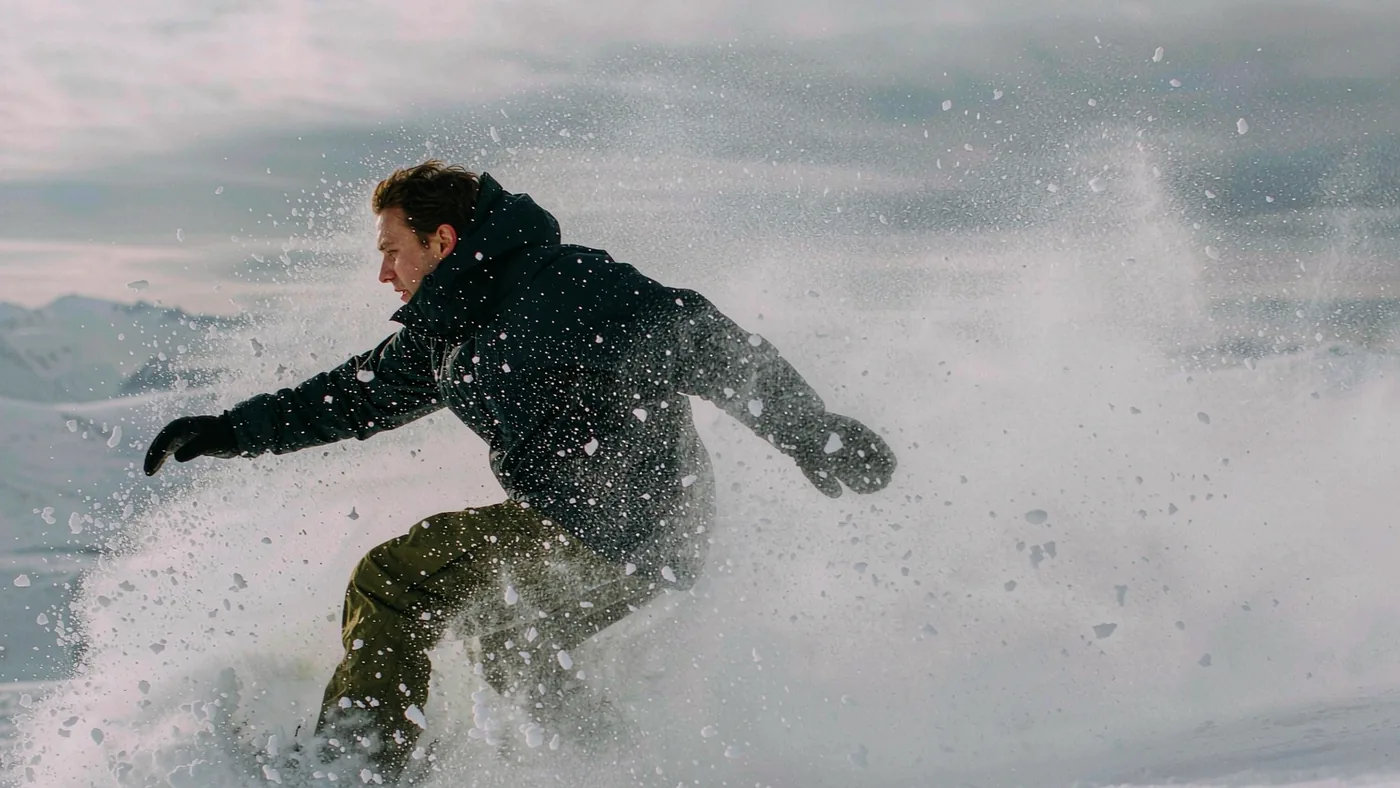
You drop off the side of the piste into waist-deep snow that nobody has touched, expecting the same run you have ridden all week with a softer surface. Two seconds later the nose digs in, your front foot stops and the rest of you does not, and you are face down in a hole with the board buried past the bindings and your goggles full of snow. You stand up, dig out, and do exactly the same thing again thirty metres further down.
The reason is simple and slightly unfair: almost everything that makes you a competent piste rider is wrong in powder. On groomed snow you balance over the edge, steer with the front foot and finish turns to control speed. In deep snow the board needs the opposite treatment, and the riders who adapt fastest are usually the ones with the least to unlearn.
This is a technique article first. The board matters, and two shapes genuinely change what is possible, but no deck rescues a rider who is still driving the front foot into the snow.
What actually matters
Weight back, but only as far as necessary. Riding powder does not mean leaning back like a waterskier. It means shifting a modest amount of weight towards the rear foot so the nose rides up rather than ploughing, then returning to centred once the board is planing. Riders who shift their whole body backwards burn their thighs out within two runs and lose all steering authority.
Speed is flotation, not a luxury. A board floats because the base pushes snow aside and the shape generates lift, and that only happens above a certain speed. Riding slowly in deep snow means the board sinks, steers unpredictably and catches, which makes you slow down further. Counter-intuitively, the safest thing you can do in a powder field is keep enough momentum to stay on top of it.
Do not try to carve. Powder has no hard surface for an edge to bite, so a carving turn simply buries the board. The turn in powder is a rounded, drifting arc with the board almost flat, steered by pressure and by the shape of the board rather than by edge angle. If you can hear your edge scraping, you are not turning in powder.
Stay on edge on the traverse, flat in the turn. Traversing a powder slope is where most people lose the plot, because a flat board slides downhill and a hard edge cuts in and stops you. The answer is a slight, continuous edge with your weight over it, pointing where you want to go. Expect to lose some height on every traverse; that is normal.
The picks
Two boards come up repeatedly when riders ask what actually makes powder easier. They answer different questions, and neither is a sensible first board.
A short, wide, tapered shape that turns a normal powder day into a good one. It is a specialist, and it is worth owning only if you get real powder days.
Best for
- Riders who get regular deep-snow days
- Anyone adding a powder-specific deck to a quiver
Worth skipping if
- One-board riders
- Anyone riding mostly groomed pistes
- Profile
- Rocker-dominant with camber underfoot
- Shape
- Tapered directional
- Flex bias
- Medium
- Intended terrain
- Freeride / powder
Strengths
- Outstanding float for its length
- Turns quickly in tight trees
- Fast, durable base
Trade-offs
- Poor on hardpack compared with a camber deck
- Only makes sense as a second board
Specifications reflect published manufacturer information, last checked 2026-09-28. We have not laboratory-tested this product; the assessment above is editorial, based on the published design and the rider profile it targets. How we review gear.
A short, wide, volume-shifted deck that rides like a much longer board but turns far quicker. The best option here if you fly with one board and want it to handle everything.
Best for
- Riders who want one travel board for all conditions
- Bigger-footed riders who need a wide waist
Worth skipping if
- Riders who want a traditional-feeling camber deck
- Dedicated park riders
- Profile
- Rocker-dominant hybrid
- Shape
- Tapered directional, volume shifted
- Flex bias
- Medium
- Intended terrain
- All-mountain / powder
Strengths
- Very short, very quick in tight terrain
- Floats far better than its length suggests
- One of the best single-board travel choices
Trade-offs
- Smaller-footed riders may find the waist too wide
- Not a carving-focused deck
Specifications reflect published manufacturer information, last checked 2026-09-28. We have not laboratory-tested this product; the assessment above is editorial, based on the published design and the rider profile it targets. How we review gear.
How they compare
| Board | Profile | Shape | Flex | Floats best when | The compromise |
|---|---|---|---|---|---|
| Jones Hovercraft | Rocker-dominant with camber underfoot | Tapered directional | Medium | The snow is genuinely deep and you want tight turns in trees | Weak on hardpack next to a camber deck, and pointless as an only board |
| Ride Warpig | Rocker-dominant hybrid | Tapered directional, volume shifted | Medium | You need one deck for powder, chop and groomed snow on the same trip | The wide waist suits bigger feet better than smaller ones, and it is not built for carving |
| Your current all-mountain board | Usually hybrid camber | Anything | Whatever it is | The powder is shallow, tracked or dense rather than waist-deep | A cambered nose dives unless you work for it all day |
Published specifications, last checked 28 September 2026. Which shape suits a given day is editorial judgement based on manufacturer specifications and rider consensus, not on measured testing.
The honest ordering of importance is technique, then snow depth, then board. A Hovercraft under a rider who leans back and stalls is an expensive way to have a bad day. A rocker-dominant all-mountain board under a rider who keeps speed and stays centred will float perfectly well in most European powder.
Using the board you already have
Move your bindings back if the board allows it, using the rear insert packs to shift the stance towards the tail. A few centimetres changes the balance point of the whole board and costs nothing.
Look further ahead than you think. In powder you cannot see what the base of the board is doing, so your eyes need to be at the point you will be in two seconds. Riders who look at the nose dig the nose in.
Get back on the piste to rest. Powder riding is more tiring than groomed riding because the legs make constant small corrections. Two or three powder runs and a groomed run is a far better day than eight powder runs and an injury.
When you dig in and stop
Sooner or later you will come to a halt with the board buried and no momentum, and what you do next decides whether you are riding again in twenty seconds or ten minutes.
Do not try to stand up on the spot. In deep snow there is nothing solid under you, and every attempt to push up drives the board deeper. Roll onto your back or front, pull the board up under you with your hands and get your weight over the middle of it. Then either point it down the fall line and let gravity start you, or reach under and grab the nose to pull it straight. A nose-down entry is the slowest possible way to start again.
If you have stopped in trees, everything above speeds up considerably. Expect to take your back foot out and shuffle, and expect it to be tiring.
Tree wells, partners and the parts that kill people
Powder is not dangerous because of the powder. It is dangerous because of what is under it and around it, and because deep snow hides both.
Tree wells are the clearest example. Around the base of a conifer, the branches shed snow and leave a buried void that can be a couple of metres deep and wider than a person. A rider who falls head-first into one can be suspended upside down with their board holding them in place, unable to reach the surface, while the snow around them collapses further with every movement. This is how fit, experienced riders die in-bounds. The rules are straightforward: ride with a partner, keep your partner in sight, and never ride a tree line alone.
Beyond that, the familiar backcountry rules apply the moment you leave a marked piste. Snow depth tells you nothing about whether the slope underneath is going to move. If you are heading out of bounds, the requirements are training, a transceiver, a probe, a shovel and a partner, and none of them is optional.
If you ride one week a year on piste, or your trip is to a resort where fresh snow is a bonus rather than the point, do not buy a dedicated powder shape. A taper-nosed freeride board or a volume-shifted all-mountain deck that still holds an edge will serve you better across a mixed week, and you can hire the specialist for the day the forecast actually delivers. Buy the Hovercraft when you have a quiver and get real powder days, not because you hope to.
Frequently asked questions
How deep does snow have to be before I need a powder board?
Most riders notice an obvious difference once the fresh snow is deeper than about thirty centimetres on a firm base. Below that a hybrid camber all-mountain board copes perfectly well. Above knee depth, shape starts to matter more than effort.
Should I lean back the whole way down?
No. Shift back enough to get the nose planing, then return to centred and let the board's shape do the work. Riders who hold a full lean-back use far more quad strength and cannot steer properly through trees.
Why do I keep falling forwards in powder?
Almost always because you slowed down in the middle of the turn. Flotation depends on speed, so a slow board sinks, the nose catches and the rotation throws you over the front. Keep the turn rounded and committed.
Can I ride powder on a cambered board?
Yes, and plenty of riders did for decades. It demands more speed, more rearward weight and more patience, and the nose will dive on flatter sections. If powder is a bonus day, ride the board you have.
What if I get stuck in a tree well?
Keep your arms close to your body to protect an air pocket and wait for your partner, who should be close enough to see you go in. This is why riding with a partner who is watching you matters more than anything else in deep snow.
Where to go next
Our round-up of the best powder snowboards covers the wider choice, and volume-shifted snowboards explains why a shorter, wider board often floats as well as a longer one. To read the numbers before you buy, see how to read a snowboard spec sheet.
If you are heading anywhere off-piste, read avalanche basics for splitboarders before you go, and browse the advice section for the rest.