It is the second morning of a week in Les Deux Alpes and the front of your back knee hurts, not from a fall but from turning. You have ridden the same board for three seasons without touching the bindings, because the shop set them up when you bought it and you have assumed ever since that a setup is either right or wrong, and yours is right. Meanwhile the board turns well at low speed, feels nervous the moment you point it down a red, and your hips complain at the end of every run.
Stance width does that. It is the least-discussed adjustment on a snowboard and one of the most consequential, because it changes where your hips sit, how much leverage you have over the edges, and how quickly the board goes from one edge to the other. It is also the easiest thing on the whole board to change: one tool and about ten minutes.
What actually sets your stance width
Four things matter, and only one of them is height.
Your build. Height is a rough proxy; inseam and hip flexibility are better ones. Two riders of the same height can need different measurements because one has five centimetres more leg and can hinge their hips further.
Your riding. Freestyle riders stand wider than carvers, and that is a design choice rather than fashion. A wide stance is a stable platform for landing and pressing; a narrow one lets you shift weight along the board, which is what carving on a firm piste rewards.
Your board. Every board has a reference stance — the width the designer had in mind, usually marked between the inserts or published in the spec sheet. Longer boards generally have a wider one, and a board ridden well outside its intended range never quite settles.
Your body's history. Knees, hips and lower back set limits that no formula knows about. If a width hurts, it is wrong, whatever a chart says.
A starting number you can actually use
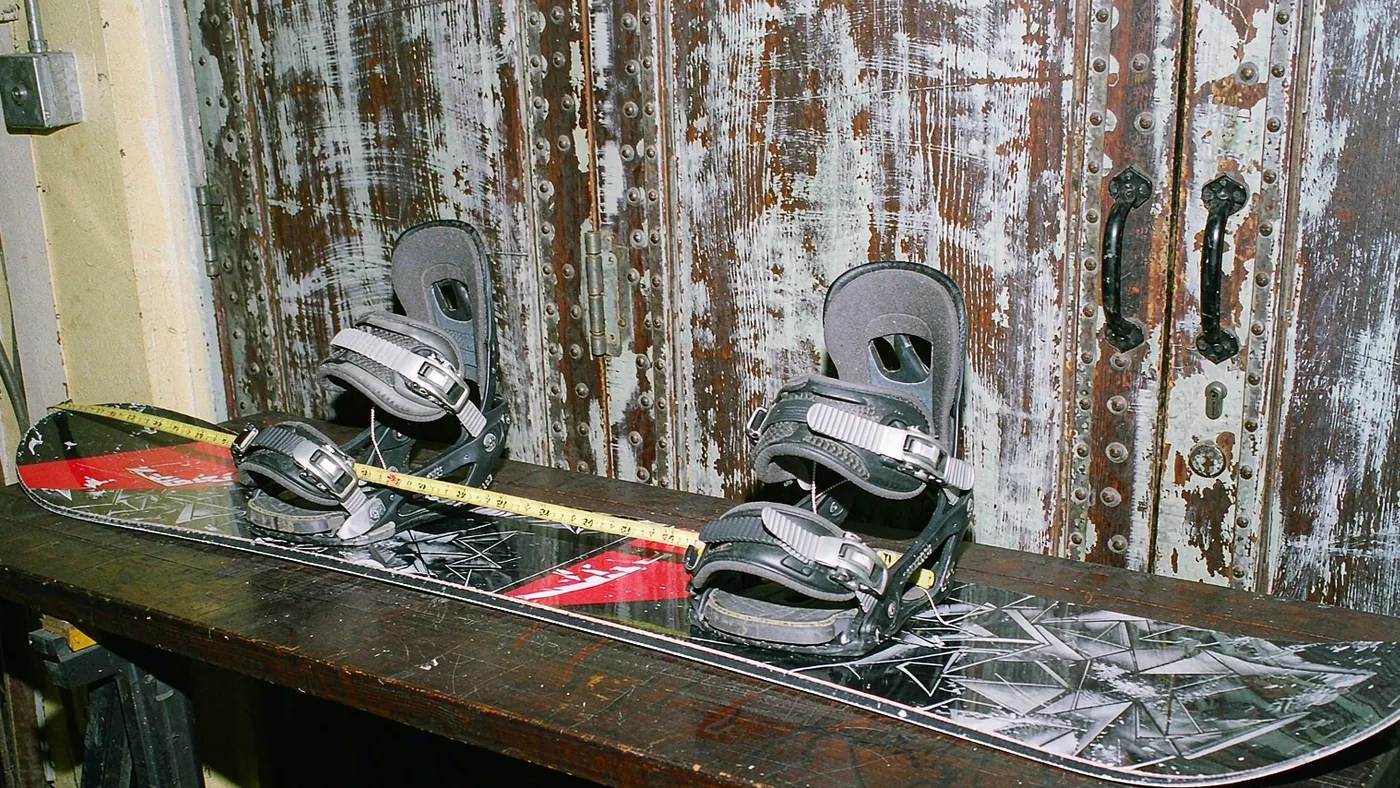
Measure between the bony points at the tops of your shoulders, then measure your board from the centre of one binding to the centre of the other. Most recreational riders land somewhere between a shoulder width and a few centimetres wider, and the way to find out whether that suits you is to start there and adjust in small steps.
| Stance width, centre to centre | Who it typically suits | What it is good at | The trade-off | Move up or down if |
|---|---|---|---|---|
| 44–48 cm | Smaller riders, tight hips, older knees | Quick edge-to-edge transitions, easy hip rotation | Less leverage at speed, less stable on landings | Up if the board feels twitchy on a firm piste; down if your stance feels cramped |
| 49–52 cm | Most recreational riders of average height | All-round piste riding and cruising | Nothing dramatic either way | Up for park or more stability; down if you feel locked and cannot shift weight |
| 53–56 cm | Taller riders, freestyle-leaning all-mountain riding | Stability at speed, presses and landings | Slightly slower to go from edge to edge | Up if you land jumps regularly; down if your front knee collapses inwards |
| 57–60 cm and above | Committed freestyle and park riders, very tall riders | A very stable platform on jumps and rails | Slow transitions, hard work on long carves | Up almost never for a recreational rider; down if you ride mostly piste |
Editorial starting bands for recreational riders on European resort terrain, last checked 28 September 2026. They describe how the adjustment usually behaves rather than any measured result, and a board's own reference stance should be your first stop.
What too wide and too narrow feel like on snow
This is the part that lets you diagnose yourself on the hill rather than in your living room.
Too narrow. The board initiates turns instantly and then refuses to settle. You feel every bump through your heels, the deck skates when you point it down a firm red, and your hips ache on the outside. Riders describe it as the board being nervous, and blame the edges or the tune, when the cause is usually a lack of leverage.
Too wide. Turns take an age to start. You cannot get your weight far enough forward to press the front of the board, so the nose washes out in soft snow and the tail skids at the end of a turn. Your front knee collapses inwards, and after two hours your hips and groin feel stretched rather than used. Presses and jumps, on the other hand, feel surprisingly easy.
About right. You can move your weight forward and back over the board without it feeling like a stretch. The board starts a turn when you ask and holds it without chatter, and nothing hurts after a full day apart from the muscles you expect.
Why park riders stand wider and carvers narrower
The two ends of the sport genuinely want different geometry.
A wider stance lowers your centre of gravity and gives you a broader base, which makes landing a jump or balancing on a rail easier, and it shortens the board behind your back foot so the tail presses and swings more readily. The cost is transition speed: the wider you stand, the longer it takes to roll from edge to edge.
A narrower stance does the opposite. Your hips can rotate and shift along the board, which lets you drive the front of the deck into a carve and finish the turn at the tail, and transitions are quicker when you are linking short turns on a steep piste. What you give up is stability, particularly in the air and in chopped-up snow at speed.
If you ride a bit of everything, that is the argument for the middle of the range above rather than the top of it, and for a board with enough insert positions to move two steps either way.
The reference stance, and how to change yours safely
Start at the manufacturer's reference stance. It is a designed position, not an arbitrary one, and for a first season it is almost always the right answer. Then record the number: measure from the centre of one binding to the centre of the other with a tape and write it down, or your next adjustment is guesswork.
When you do adjust, move one insert position at a time — usually about two centimetres — and ride at least half a day before deciding. Change width and angles separately, or you cannot tell which one helped.
Check the bindings are centred on the board's waist while you are there, and that both feet sit the same distance from the centre. A stance that is asymmetric by one insert position is a common inheritance from a previous owner, and it makes the board feel as though it turns differently in each direction — which our guide to riding switch covers from the technique side.
Verdict
If your current stance is comfortable, your turns start when you ask and nothing hurts after a full day, do not change it because a table suggests a different figure. Riders with knee, hip or back issues should treat these bands as a starting point for a conversation with a physio or a boot fitter rather than a target, and anyone on a board with a fixed, narrow insert pack should work with the positions available rather than drilling new ones.
Frequently asked questions
Should my snowboard stance be shoulder width?
Roughly, as a starting point. Measure between the bony points at the tops of your shoulders and compare it with the distance between the centres of your bindings. Most recreational riders end up at or slightly wider than shoulder width, while park riders go wider and carvers narrower.
How do I measure my stance width?
Measure from the centre of one binding's baseplate to the centre of the other, with both mounted. That number, written down, is what lets you return to a known setup after experimenting, and it is more reliable than counting insert positions.
How much does height affect stance width?
Less than riders assume. Inseam and hip flexibility matter more, and two riders of 180 cm can comfortably ride two centimetres apart in stance. A rider with a long torso and short legs usually wants a narrower stance than their height suggests.
Why does my back knee hurt when I ride?
A stance that is too wide for your hips is a common cause: the front knee collapses inwards and the back leg is left stretched. Binding angles that force the knees to track inwards are another. Change one variable at a time and give each change half a day on snow.
Where to go next
Angles are the next adjustment — binding angles explained covers duck stance, positive angles and knee tracking, and how to set up snowboard bindings is the step-by-step mounting guide. If you are choosing a board around your stance, the snowboard size chart handles length and waist width, and the park beginner board guide explains what a freestyle deck is designed to do. Everything else sits in the buying-guides archive.