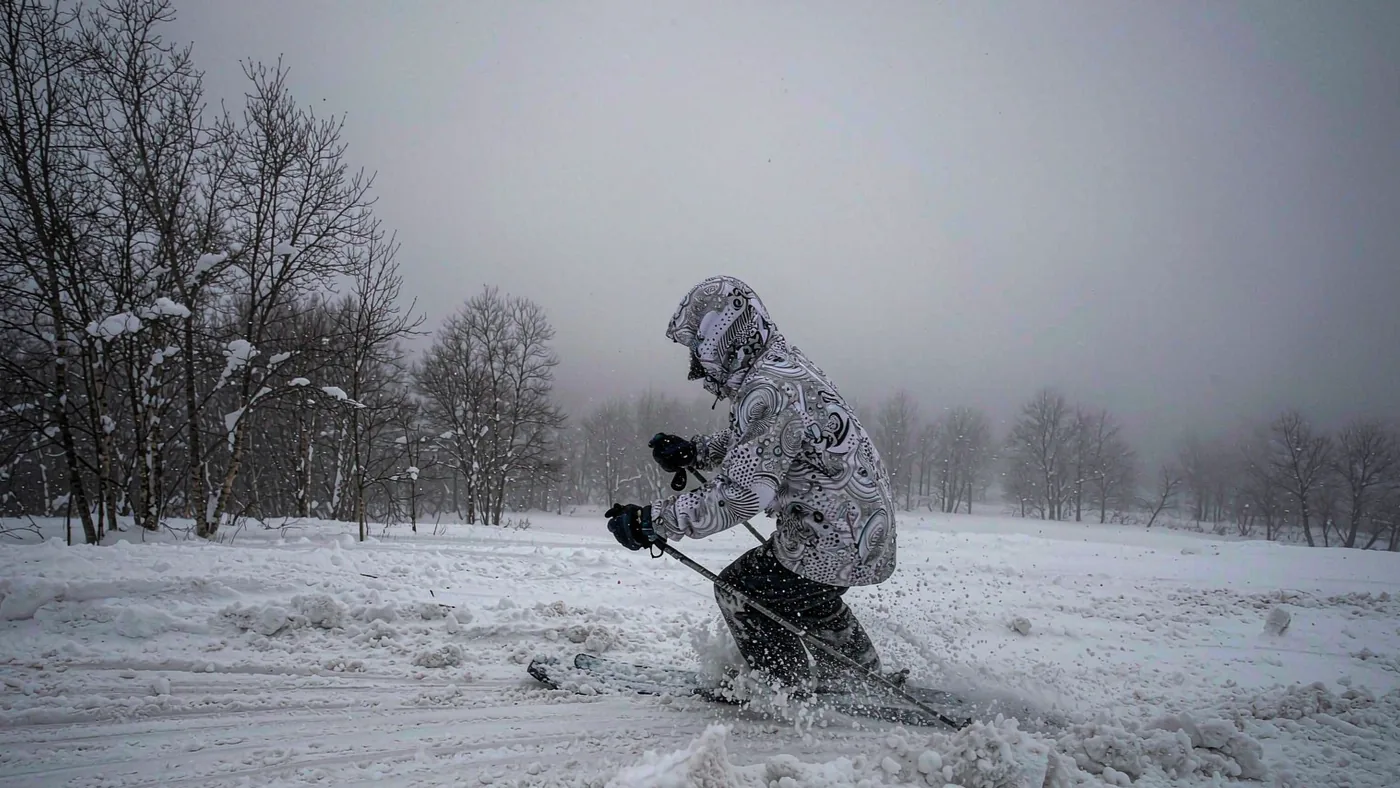
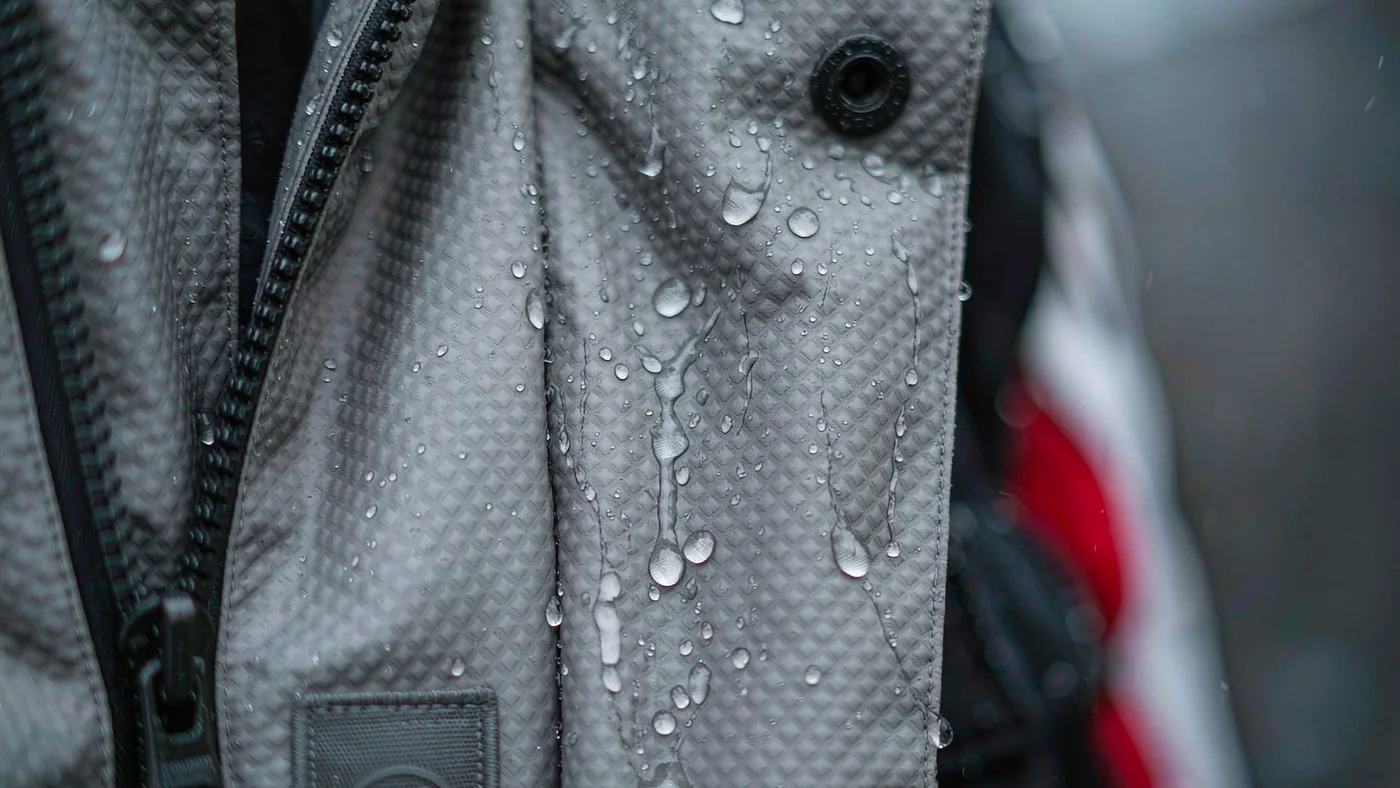
By two o'clock your shoulders are cold and heavy, and the water is not running off your jacket any more. The face fabric has gone dark and flat, it feels clammy against your midlayer, and water that was beading off in the morning is now soaking in. Nothing has torn and the seams have not failed. The jacket has simply saturated, and once the outer fabric holds a film of water, the breathability you paid for stops working entirely.
This is the part of waterproofing that no label explains. Jackets are sold on two numbers — a waterproof rating in millimetres and a breathability rating in grams — and both describe a flat piece of clean fabric in a laboratory with nothing on top of it. Read them as a filter for the obvious non-starters, not as a league table. What decides whether you have a good day is mostly the construction around the fabric and what happens to the finish over a season.
The two numbers, and what they actually test
Hydrostatic head, in millimetres. A column of water is pressed onto a sample of fabric until it starts to pass through, and the height of the column at that point is the rating. Five thousand millimetres is showerproof and water-resistant. Ten thousand is fine for most resort days. Twenty thousand is the sort of number used for serious wet weather. It is a real, standardised test, measured on flat fabric with no seams, no zips and no pockets.
Breathability, in grams per square metre per twenty-four hours. This is a moisture-vapour transmission rate: how much water vapour passes through a square metre of fabric in a day, under whatever conditions that laboratory test specifies. More than one test method exists, and the methods do not give comparable numbers, so two figures cannot be ranked against each other even when one is visibly higher.
Neither number covers the jacket as worn. A fabric test does not tape seams, fit zips or abrade the face fabric against a lift bar. A jacket with a 20,000mm fabric can leak through an untaped seam, and a jacket with a 10,000mm fabric and fully taped seams can stay dry all week.
| Rating band | What it means in practice | Where it is enough | What it is not |
|---|---|---|---|
| 5,000mm | Water-resistant; light rain and dry snow | Indoor slopes, dry cold resort days | Any sustained wet snow |
| 10,000mm | Waterproof for normal resort use | Most Alpine days, including spring slush | Long days in wet snow or rain |
| 15,000mm | Comfortably waterproof | Wet snow at low altitude | Sitting on a wet lift for a week |
| 20,000mm and above | Top of the conventional range | Scotland, rain, wet continental snow | A substitute for taped seams and vents |
Rating bands are long-established industry conventions rather than measurements of any jacket on this page. Published specifications, last checked 28 September 2026. How each band feels is an editorial judgement.
Coating or membrane — the difference that decides everything
Both a membrane and a coating can carry the same waterproof rating. They behave very differently over time.
A membrane is a thin film with pores or a chemical structure that lets vapour through while water cannot pass. As long as the membrane is intact it keeps working, and the fabric around it can scuff and look exhausted without the waterproofing failing. This is why the better jackets are quoted with a named membrane rather than a number.
A coating is sprayed or spread onto the inside of the face fabric. It is cheap, thin, and it abrades. Flex the jacket at the shoulders, wear it against a lift bar, wash it a few times, and the coating thins where it is worked hardest — usually exactly where you need it. Coatings are also much harder to restore once they start to go.
There is a third element, and it applies to both: the durable water repellent finish on the outside of the fabric, which is what makes water bead and roll off. Every jacket has one, every one wears out, and none lasts more than a handful of washes. Losing it does not make the jacket leak, but it does make the jacket heavy, cold and unable to breathe, because a layer of water on the outside blocks the movement of vapour through the fabric.
The picks
A genuine waterproof shell rather than a fashion jacket. Built for the wet, heavy snow you actually get in Scotland and the lower Alps.
Best for
- UK and Scottish riding
- Riders who ride in the rain
Worth skipping if
- Riders who run hot inside a warm jacket
- Waterproofing
- GORE-TEX membrane
- Insulation
- Shell, no insulation
- Hood
- Helmet compatible
Strengths
- Keeps out genuinely wet snow
- Layers well over a mid-layer
Trade-offs
- Shell only, so you need to layer properly
- Premium price
Specifications reflect published manufacturer information, last checked 2026-09-28. We have not laboratory-tested this product; the assessment above is editorial, based on the published design and the rider profile it targets. How we review gear.
A solid, unfussy jacket at a price that leaves budget for boots. Not the most technical fabric, but it does the job in a normal European winter.
Best for
- Riders on a budget
- Resort riding in normal conditions
Worth skipping if
- Serious wet-weather riding
- Backcountry
- Waterproofing
- Coated waterproof fabric
- Insulation
- Light synthetic
- Hood
- Adjustable
Strengths
- Good value
- Warm enough for most resort days
Trade-offs
- Coating needs reproofing over time
- Not built for sustained rain
Specifications reflect published manufacturer information, last checked 2026-09-28. We have not laboratory-tested this product; the assessment above is editorial, based on the published design and the rider profile it targets. How we review gear.
How they compare
| Jacket | Waterproofing | Construction | Insulation | Best suited to | Main trade-off |
|---|---|---|---|---|---|
| Volcom L GORE-TEX | GORE-TEX membrane, taped seams | Shell with a laminated membrane and a helmet-compatible hood | None of its own | Wet snow, Scottish riding, riding in rain | You must layer underneath, and it is the pricier choice |
| DC Command | Coated water-resistant fabric | Lightly insulated jacket with an adjustable hood | Light synthetic | Normal resort days on a budget | The coating needs reproofing and will not handle sustained rain |
Descriptions follow published manufacturer information, last checked 28 September 2026. The judgement about which rider each jacket suits is editorial, not a measured test result.
Breathability is the number to distrust most
Breathability figures are quoted in grams, and the bigger the number the better the jacket is supposed to be. In practice it is the least reliable number on the label.
First, the tests differ. Some laboratories quote a moisture-vapour transmission rate and others quote a resistance figure where lower is better, and the two are not convertible by a rule of thumb. Second, the test measures a fabric sample in a controlled environment, whereas your jacket sits under a pack strap, against a midlayer, in damp air at a low temperature. Third, and most importantly, the breathability of a saturated shell is close to zero. If the face fabric is holding water, vapour cannot leave, whatever the laboratory measured.
That is why a jacket's vents, pit zips, hem and cuffs matter more than its breathability number. Venting moves far more moisture than any membrane, and it does not wear out.
What matters more than the number
Fully taped seams. The cheapest jackets tape only the critical seams, which usually means the shoulders and the chest. The ones that take water in a long day are elsewhere.
Water-resistant zips with storm flaps. Any zip that is not protected is a hole.
A hood that stays up, and vents you can open with gloves on. Wet weather arrives with wind, and a hood that flaps loose leaves your neck exposed. If you cannot work a vent zip on a chairlift without taking a glove off, you will never use it.
When a modest rating is fine, and when a big one is not enough
A low rating is entirely adequate in dry cold. In a continental resort at minus ten with dry snow, the jacket's job is mostly wind and spindrift, and a 10,000mm fabric with good seams will keep you comfortable all week.
A high rating is not enough in wet snow on its own. In Scotland, or at low altitude on a mild day, the limiting factor is usually the finish and the seams rather than the headline number. If you ride wet snow often, spend on a laminated membrane and a jacket you can reproof.
Verdict
If you ride a dry, cold week at altitude and you never ride in rain, a 10,000mm jacket with taped seams is the sensible place to stop, and the extra money is better spent on boots. The rider who does benefit from the top of the range is the one who rides wet, heavy snow at low altitude, in Scotland, or in the rain, and who will wash and reproof the jacket once a season.
Frequently asked questions
Is 10,000mm waterproof enough for snowboarding?
For most resort riding, yes. A 10,000mm fabric with fully taped seams handles dry snow, spring slush and a light shower. If you ride wet snow at low altitude, or in actual rain, look at 20,000mm and a membrane rather than a coating.
What does g/m²/24h mean on a jacket label?
It is a moisture-vapour transmission rate — the grams of water vapour that pass through a square metre of fabric in twenty-four hours under that particular test. Higher is better, but figures from different tests cannot be compared directly, and a saturated outer fabric breathes almost not at all.
What is the difference between a coating and a membrane?
A coating is applied to the inside of the face fabric and wears away where the jacket flexes, which is why coated jackets fail first at the shoulders. A membrane is a separate film bonded into the fabric, and it keeps working as long as it is intact. It costs more and generally lasts longer.
Do I need to reproof a waterproof jacket?
Yes, at least once a season with regular use. The durable water repellent finish is what makes water bead and roll off, and it wears out with dirt, oils and washing. When the fabric starts soaking up water and feeling heavy, it is due for a wash and a reproof.
Where to go next
The best snowboard jackets for British winters applies all of this to wet, low-cloud riding, and the best midlayers for snowboarding explains the layer that has to work underneath a shell. If the wet is reaching your waist rather than your shoulders, read the best snowboard pants and bibs guide.
Terms like membrane, laminate and DWR are collected in the snowboard gear glossary, and more buying advice sits in buying guides.