Half past three on a February afternoon in the Val di Fassa, and the long cat track back towards the lift is flat enough that everyone has to work. Your mate is on a tapered directional deck, sitting slightly back and fighting the board as it drifts towards the uphill side. You are riding switch because your legs are tired, and your board is tracking straight without any effort from you. Neither of you is doing anything clever. The boards are simply shaped differently.
Shape is the part of a board that riders discuss least and feel most. Flex and profile get the arguments; the outline decides where the board goes when you stop telling it anything. The honest position: if you ride switch for more than a third of your time on snow — and most riders who claim otherwise do not — a true twin is worth its small penalties. If you barely ride switch at all, a directional shape gives you float, a stronger tail and a better ride everywhere else, and a twin is symmetry you will never use.
What actually matters
Nose and tail symmetry. A true twin is symmetric end to end, so the board loads and releases identically whichever way you point it. A directional shape is not, which means that ridden backwards it is a board designed to go forwards. The difference is small on a groomed run and obvious in soft snow.
Taper. Taper is the difference in width between the nose and the tail, with the tail narrower. It sinks the tail slightly and lifts the nose, which is why a tapered board floats with less effort than its length suggests. Taper is the most useful thing a directional shape does and the main reason switch feels odd.
Set back. Set back moves the stance towards the tail, putting more weight behind the board's centre. A small set back lets you stay centred in powder instead of leaning on the back leg all day. On a true twin the stance is centred and you make that up with your body.
Effective edge and sidecut. A twin's sidecut is symmetric, so a carved turn finishes the same in both directions. A directional board places more effective edge in front of you, which gives a stronger turn finish going forwards and a vaguer one going backwards.
The picks
A twin that still holds an edge. Better than most twins in crud, and happier in the park than most all-mountain boards.
Best for
- Riders who want switch riding without giving up grip
- Resort riders who mix piste and park in one lap
Worth skipping if
- Deep-day powder hunting
- Riders who want a soft, jib-friendly feel
- Profile
- Hybrid camber
- Shape
- True twin
- Flex bias
- Medium
- Intended terrain
- All-mountain freestyle
Strengths
- Strong grip for a twin
- Handles chunder better than the flex suggests
- Solid eco-credentials with no performance penalty
Trade-offs
- Overkill if you never ride switch
- Notably more expensive than comparable twins
Specifications reflect published manufacturer information, last checked 2026-09-28. We have not laboratory-tested this product; the assessment above is editorial, based on the published design and the rider profile it targets. How we review gear.
A short, wide, tapered shape that turns a normal powder day into a good one. It is a specialist, and it is worth owning only if you get real powder days.
Best for
- Riders who get regular deep-snow days
- Anyone adding a powder-specific deck to a quiver
Worth skipping if
- One-board riders
- Anyone riding mostly groomed pistes
- Profile
- Rocker-dominant with camber underfoot
- Shape
- Tapered directional
- Flex bias
- Medium
- Intended terrain
- Freeride / powder
Strengths
- Outstanding float for its length
- Turns quickly in tight trees
- Fast, durable base
Trade-offs
- Poor on hardpack compared with a camber deck
- Only makes sense as a second board
Specifications reflect published manufacturer information, last checked 2026-09-28. We have not laboratory-tested this product; the assessment above is editorial, based on the published design and the rider profile it targets. How we review gear.
How they compare
| Shape family | Nose and tail | Stance | Where the width goes | Who it suits |
|---|---|---|---|---|
| True twin | Identical | Centred | Even | Riders who ride switch a lot and land jumps backwards |
| Directional twin | Same outline, stiffer tail | Slightly set back | Even, with a stronger rear half | Riders who want switch without giving up grip |
| Directional | Longer, softer nose | Set back | Narrower tail | Piste riders who want one good direction |
| Tapered directional | Noticeably longer nose | Set back further | Narrower tail, often volume shifted | Soft-snow riders who want float for free |
Published specifications, last checked 28 September 2026. Which shape suits which rider is an editorial judgement about how the outline behaves, not a measured comparison.
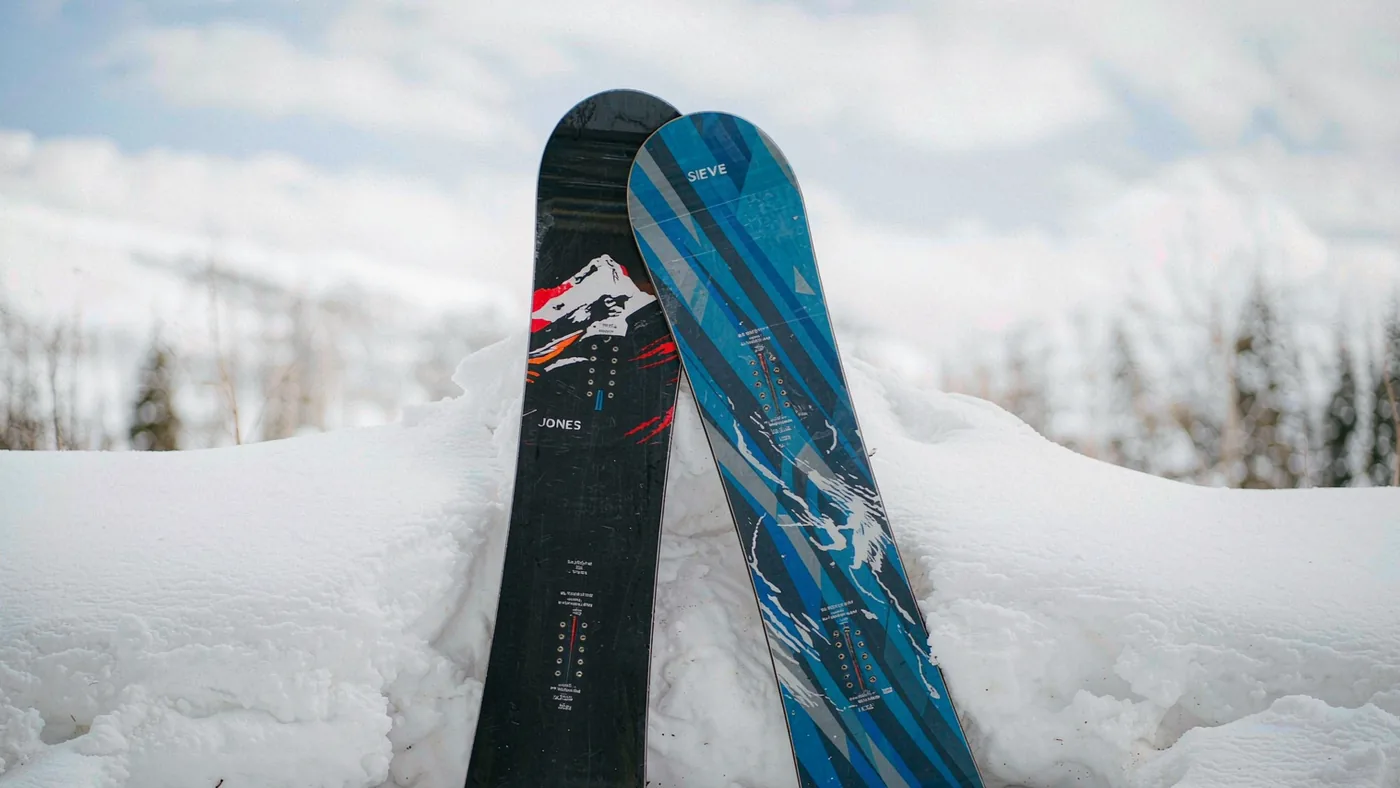
Two decks show the ends of that table. The Jones Mountain Twin is a true twin with a hybrid camber profile and a medium flex, aimed at riders mixing piste and park in one lap, and it is the rare twin that behaves itself in chopped snow. The Jones Hovercraft goes the other way entirely: a tapered directional shape, rocker dominant, short and wide, built to float and turn quickly in trees and worth owning only if deep snow is genuinely part of your season.
How much switch riding justifies giving up float
Under a tenth of your time. Buy directional. A symmetric board costs you nose float, a stronger tail and turn finish, and you will never notice the benefit.
Roughly a third of your time. Buy a directional twin. You get most of the switch feel while keeping a firmer tail and a small setback, which is the compromise most riders should make.
Half your time or more, or any time in the park. Buy a true twin. If you land jumps backwards and spend afternoons on boxes, symmetry stops being optional.
Building for one specific trip. Buy the shape for the trip. Hiring a tapered directional deck for a powder week is a better use of money than reshaping a quiver around a holiday you take every third year.
What the compromise costs
A true twin in soft snow. You work harder for float, sitting back over the tail rather than relying on the shape to lift the nose. On a deep day a twin of the same length feels shorter and heavier-legged than a tapered deck.
A twin on hard, fast pistes. The turn finish is less decisive at the end and the board wants more input to hold a long arc. Grip is not the problem so much as how the turn closes.
A directional shape ridden backwards. Everything softens at once: turn finish, landing stability, the sense of where the tail is. Rideable, but a compromise rather than a design feature.
A tapered directional deck as an only board. The expensive mistake. Taper and setback are superb in soft snow and only adequate on firm, scraped pistes.
The rider weight question
A twin and a directional board of the same length do not carry weight the same way, and the gap widens with the rider.
A true twin spreads your weight evenly between the inserts, so the whole running edge takes load in a turn. A directional shape puts more effective edge in front of you, which is why it tracks a long turn better and can feel like it is steering you. A heavy rider on a soft directional deck finds the tail gives up first, because there is less of it. A light rider on a stiff, set-back deck finds the nose ploughs however they stand. Read the weight range for the specific length, not the length you used to ride.
Verdict
If you never ride switch, do not buy a true twin however well reviewed it is. You are paying a premium for symmetry that does nothing for you and giving up the nose float, the stronger tail and the turn finish a directional shape provides. Equally, do not buy a tapered directional deck as your only board if your season is mostly groomed pistes — it is the wrong tool for the surface you ride, and you will spend the week compensating.
Frequently asked questions
Does a true twin really matter if I hardly ride switch?
Rarely. A directional twin with a small setback gives better float and a stronger tail for almost no cost. Symmetry only pays off when you genuinely spend time landing, carving and tracking on your other foot, which most riders overestimate by a wide margin.
Is a true twin worse in powder?
It floats less for the same length, because it has no taper or setback to lift the nose. You can compensate by riding a slightly longer twin and shifting weight back, or by setting the stance back if the inserts allow it. A tapered directional deck simply needs less effort.
Can you ride a directional board switch?
Yes, and many riders do it on groomed snow without complaint. What changes is the feel: the tail is narrower and softer, so the turn finishes less crisply and landings are less predictable. If you plan to ride switch down whole runs in deep snow, that is where it costs you.
What does taper actually do?
Taper means the tail is narrower than the nose, which lets the tail sink and the nose lift. That one change gives a directional board float with less effort than its length suggests, and it is why tapered shapes dominate powder and freeride ranges. It also makes switch riding vaguer.
Should I set my stance back on a twin?
Only if the inserts allow it and you are riding soft snow. One insert position back helps the nose float at the cost of making the board feel shorter and less balanced when you ride switch, which defeats the reason you bought a twin. A longer twin is usually the better answer.
Where to go next
If you have settled on a shape, all-mountain vs freestyle explains how flex and profile change the same outline, and all-mountain vs freeride covers what happens when you push a twin into steeper, faster terrain. Riders who want the symmetric option in detail should read our twin tip round-up.
For the rest of the setup, the waist width guide stops boot drag deciding your next board for you, and the stance width guide gets your feet in the right place before you blame the shape.